Sega Genesis Games That Pushed The Limits of Graphics & Sound

See Other Entries of the Games That Pushed The Limits Series
I have been recently been fascinated by the history of the various machines that have battled for our living rooms. Each machine has had its strengths and weaknesses, and as a programmer, I’m amazed by some of the ways developers have harnessed the power of consoles and pushed them to their limits resulting is some marvelous games.
I usually try to emphasize that gameplay is more important that graphical quality. However, I thought it would be interesting to take a look at games that were the most demanding when it came to a console’s limited system resources.
Long-time readers of this site may realize this is an expanded and revised article that I am still trying to perfect. That said this project is still a bit of a work in progress, so If you think I missed any games, please feel free to leave a suggestion with an explanation in the comments section.
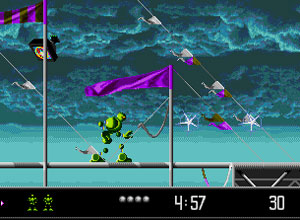 Vectorman & Vectorman 2
Release Date: October 24, 1995 & November 15, 1996 respectively
See Game In Action
Key Techincal Features:
- Used pre-rendered 3D models to give the game a “next-gen” look
- Pieces of characters individually animated
- Beautiful, scrolling backgrounds
- Cranked out more colors with highlight/shadow technique
- Huge bosses
What Makes The Game Special:Vectorman was obviously Sega’s answer to the Donkey Kong Country series and its pre-rendered, 3D-like graphics. Fortunately, for Sega fans, Vectorman not only looked beaufitul, but also provided some animations that were even more impressive than DKC.
Vectorman’s developers, Blue Sky Software, made use of an impressive new program called “Vector Piece Softwareâ€, which allowed the spheres making up Vectorman’s body to be individually animated. This software techinique allowed the Vectorman character to move smoothly and glide in and out of his various transformations.
According to Vectorman’s head developer, Richard Karpp, A large percentage of the levels implemented a creative use of the Genesis’ scrolling backgrounds For example, it was possible to specify a different scroll offset for each horizontal line, which could give a parallax effect. It was used vertically in a few levels as well, even though vertical scrolling was limited to 8 pixel chunks. Some examples for of its uses were for waterfalls and the conveyor belts.
The bosses were all designed around this scrolling technique as well. The first boss that you encounter in the game, which looks like a fighter plane, is actually implemented in the second scrolling playfield, and they used scroll offsets to make it look like it was rotating.
One of the more subtle effects we used was the highlight/shadow mode of the Genesis, which allowed the artists to use more on-screen colors than games typically used. To round out the rest of the graphical effects, you can see dust motes above light fixtures, shimmering arctic waterfalls and some impressive lightning effects. This late Genesis title kept Sega fans interested as Sega prepped the Saturn.
Gunstar Heroes 
Release Date: September 9, 1993
See Game In Action
Key Technical Features:
- Intense graphical effects such as warping, scaling, and rotation
- Mulit-sprite bosses
- Slowdown-inducing combat due to explosions & many character sprites at once
What Makes The Game Special: Its nearly impossible to talk about the Genesis and technical mastery and not have Gunstar Heroes come up in the conversation. If there was one developer that knows how to push 2D consoles to their limits, it’s Treasure (the same group that brought you Contra on the NES). This run-n-gun classic has mobs of sprites that litter the screen at any one moment. The two player game features a moderate amount of slowdown, but it’s not enough to significantly detract from the game.
Every graphical element in Gunstar Heroes is impressive: from the rotating, pseudo-polygonal intro logo to the warping, scaling, and rotation effects throughout the actual game. And, much like Metal Slug, the bosses in Gunstar Heroes are made up of tons of sprites that move and jiggle independently. Not only did Gunstar Heroes’ graphical effect enhance the visual appearance of the game, but it also help increase the variety of the gameplay.
No other game on the Genesis pushed the system as far as this technical marvel. In fact, nothing on the Super Nintendo scaled objects as well, or moved this fast or smoothly with the possible exception of a few Super FX chip games.
Alien Soldier

Release Date: February 24, 1995
See Game In Action
Key Technical Features:
- Large, well-animated character sprite
- High quality sound effects and voices
What Makes The Game Special: This run-n-gun is considered one of the hardest games ever developed by the cult-classic factory, Treasure, and was released only in Japan and Europe. It is very difficult to find in either region.As usual, Treasure really put a lot of creativity into Alien Soldier’s graphics and animation. The characters are large, extremely detailed and fluidly animated. The backgrounds are also quite detailed, and in fact are some of the best I’ve ever seen on the Mega Drive.
Treasure excelled in the music and sound effects departments as well – several extremely clear voices can be heard throughout the game (a feat thought to be near impossible due to the Genesis’ dated sound chip), there are lots of meaty explosions throughout your battles.
It is obviously a shame that this title never made it to the States as it is one of the most technically superior games for the console.
Panorama Cotton

Release Date: 1994
See Game In Action
Key Technical Features:
- Looks like a 3D game, but doesn’t use polygons
- Lush landscapes with Genesis’ limited color palette
What Makes The Game Special: This European shooter had incredible 3D effect backgrounds, making the MegaDrive hardware do things that the Nintendo fanboys claimed were impossible on the Sega machine.The game plays much like Space Harrier and Burning Force. It looks much better than the Genesis versions of those two titles and its pseudo-3D line scrolling hasn’t aged all that badly. This shooter set in an anime-style fantasy world. Various levels scroll “into the screen”, vertically, horizontally, or diagonally. You can move Cotton over the screen, shooting at oncoming enemies and avoiding obstacles on her way.
Panorama Cotton is gorgeous to look at as it makes some of the best use of the Genesis’ color palette I’ve ever seen and the backgrounds are ripe with detail. The line scrolling effect is still impressive, even if the overall scaling may seem slightly choppy to a modern gamer’s eye.
Virtua Racing

Release Date: 1994
See Game In Action
Key Technical Features:
- One of the few fully 3D games of the 16-bit era
- Included the Sega Virtua Processor on an extra chip inside the cartridge
- Supported widescreen output
What Makes The Game Special: Even though this 3D racer used a built in chip and wasn’t quite as good as the arcade original, it was awe-inspiring to see running on the Genesis. (The game’s initial price tag was equally jaw-dropping.)
While the Genesis is still technically impressive, the port ultimately suffered from choppiness, color dithering, and low polygon count. Because of that, this was the only game that used the extra chip. The Genesis version also runs at a much lower frame rate than the arcade, but animates quickly to make it seem faster.
Compare To Other Versions: Virtua Racing Port Comparison
Contra: Hard Corps
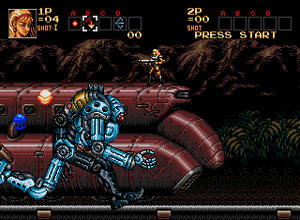
Release Date: September 14, 1994
See Game In Action
Key Technical Features:
- Slick graphical effects such as scaling and rotation.
- Huge bosses
- Pseduo-3D stages
What Makes The Game Special: Hard Corps is the fourth major installment in the Contra series of games by Konami. The game retained the fast-paced “run ‘n gun†gameplay from previous titles but slightly shifted focus from fighting onslaughts of enemy troops and vehicles to mainly boss encounters. (Much like Alien Soldier)
This shooter had a healthy dose of eye candy sprinkled with scaling and rotation effects. Hard Corps also had some awesome backgrounds and level designs that rivals the SNES version of the series in every way.In addition to it’s technical achievements, Hard Corps is quite challenging, but you’ll want to play repeatedly in order to gradually improve. Most bosses are easy once you know their patterns, but some will keep you on your toes every time you fight them. The regular enemies, when they’re around, come at you very fast and from all angles.
 Dynamite Headdy
Release Date: August 4, 1994
See Game In Action
Key Technical Features:
- Smooth and varied character animation
- Impressive use of color
- Treasure’s knack for showing off cool graphical tricks
What Makes The Game Special: This Treasure action/platformer was not quite as spectacular as Gunstar Heroes, but Dynamite Headdy has everything you look for in a Treasure game: Crazy special effects, tons of sprites with little to no slowdown, an interesting weapons system, psychotic bosses, and trademark Treasure strangeness.
The sprites of Headdy and the other characters are well drawn with superb animation between them, even the least important sprite looks cool. Headdy himself has tons of animations due to his vast amount of heads each one looking better or as good as the last.
Castlevania Bloodlines

Release Date: March 17, 1994
See Game In Action
Key Technical Features:
- Graphical effects such as translucency, mirroring, parallax scrolling, cloud effects,& transparency
- More big bosses
What Makes The Game Special: In its early years, the Castlevania series was known for being a console-pusher on the NES and SNES. Bloodlines on the Genesis keep up this tradition with its ability to do translucency, mirroring, parallax scrolling, cloud effects, transparency, and other graphical feats that pushed the system’s powers (the swaying tower, for instance, or the rolling statue head.)
One particularly impressive use of the graphics is at the top of the Leaning Tower. During this battle you fight a huge gargoyle and the camera rotates around the action. Although these effects look lackluster when compared to the Super Nintendo, but it goes above and beyond on the older Genesis hardware.
Bloodlines is the only Castlevania title to be released on the Genesis but plays much like Super Nintendo’s Castlevania IV. The graphics aren’t as detailed or colorful as the SNES version, but it achieved many effects that otherwise wouldn’t be possible on the system. Many of the bosses are very large and are composed of many sprites that combined into one entity.
Comix Zone
 Release Date: 1995
See Game In Action
Key Technical Features:
- Some of the best use of color on the Genesis
- Dynamic backgrounds
- Near CD-quality sound effects
What Makes The Game Special: This brawler is an extremely original and visually impressive game which immerses you in a comic book world. It’s probably one of the coolest games on the Genesis due to its colorful and unique style.
The game’s comic book panel construction has been expertly crafted. The designers seem to be heavily experience in how a graphic novel is constructed in order to produce an authentic look and feel. Being a late Genesis title, Comix Zone uses the full visual capabilities of the Genny in order to provide a rich and dynamic experience.
You can leap out of the page and back down into the next panel, perhaps even shortcut to the panels below. Add in the ability to rip loose chunks of the page itself to make deadly paper airplanes, or the power to punch an enemy through the ink boundaries of the panel and you have a fresh twist to the beatemup genre.
The game’s many characters are all finely animated and the backgrounds are highly detailed and dynamic. The game’s music and sound effects are nearly as powerful as the graphics. Each and every sound effect in the game is unique, from the sound of a punch connecting, to the sound of a loud explosion. Comix Zone also utilizes some good vocal clips for added realism that will only be outdone by Sega CD titles.
Ranger-X
 Release Date: 1993
See Game In Action
Key Technical Features:
- Maximized color capabilities
- Expert use of parallax scrolling
- Psuedo 3D effects
- Again with the huge bosses
What Makes The Game Special: This is one of the earliest Sega Genesis games on this list, so it’s graphical effects are especially worthy of praise. The most notable accomplishment is the developer’s use of the Genesis’s limit of 64 colors. There is a rumor that Gau was able to exceed the Genny’s color limit, but I haven’t seen confirmation other than the results on the screen.
While it’s not SNES quality, it’s far superior to most offerings on the Genny. Beyond that, the amount of parallax in the backgrounds is still impressive today, and the pseudo 3D line scrolls were mind-blowing in 1993. One of the later stages is set upon a background that is entirely made of line scrolls and the effect is staggering. There are also plenty of unique bosses in Ranger-X, most of whom take up very large portions of the screen. Overall, at a glance, Ranger-X could pass for an early Saturn or Playstation 2D game.
Honorable Mentions:
- Sonic and Knuckles – Not only did this last 2D console Sonic game have some beautiful backgrounds, animation, and a sweet 3D-ish title screen, but its also was the only game to have its special Lock-On cartridge format. It allowed you to attach the older Sonic carts into it and play Knuckles in those games. (eBay)
- Sonic the Hedgehog 2 – The main game wasn’t too demanding for the Genesis, but it’s psuedo-3D bonus rounds blew my mind in 1992 and they split-screen multiplayer mode brought the Genesis to a crawl when rings were flying everywhere. (eBay)
- Flashback: The Quest for Identity – Touted as a “CD-ROM Game on a Cartridgeâ€, Flashback: The Quest for Identity was one of the most graphically impressive Genesis games in its day. The game features fully hand-drawn backdrops and for its time remarkably fluid rotoscoped animation of walking, running and jumping movements, reminiscent of the earlier Prince of Persia. (eBay)
- Thunderforce IV (Lightening Force) – Thunder Force IV went by the name Lightening Force (sic) in the States and is possibly one of the best shooters on the Genny. Of course, this is all on top of providing stunning sci-visuals that makes every shmup fan happy. (eBay)
- Ristar – One of the most colorful platformers on the Genesis, Ristar demonstrates skilled developers mixing, shading, filtering colors to cheat the Genesis’s hue limitations. (eBay)
- Disney’s Aladdin – There were a number of impressive Disney-based games in the 16-bit era, but Aladdin does the best job of bringing the smooth and detailed animation of the film to the Genesis’s more limited medium. (eBay)
- Beyond Oasis – Sega’s attempt at making their own Zelda clone was filled with some beautiful sprites and impressive use of color. Unfortunately, Beyond Oasis didn’t have the character and story to match Nintendo’s powerhouse franchise. (eBay)
- Flink – This rather obscure 2D platformer was originally developed for the CD-based platforms, but managed to keep it’s large sprite when brought to the Genesis. Many have compared Flink‘s style to the original Rayman game that wasn’t brought out until the 32-bit generation. (eBay)
Affiliate programs and affiliations include, but are not limited to, the eBay Partner Network or Amazon Associates.


Hi George.
I read your posts and although I agree with 90 odd percent of what you say, there is a couple of issues I have with your advice re over clocking consoles. I looked out my prized megadrive and after overclocking the cpu, the machine failed to power up. I have undone the mod but it still won’t power on
Can you explain to me what the correct procedure is for oc’ing a megadrive? (And also how to fix a dead megadrive!) Many thanks
Chaos engine, such smooth graphics, and the music..
Where are Duke Nukem 3D, Batman & Robin, Sonic 3D, or Toy Story?
No one mentioned the Pagemaster. The game is top notch. It deserves to be in the top 10 for sure.
Timeless Adventures of Micky Mouse is surprisingly great too.
I recon Atomic runner could be worthy of a mention – but that aside this is a solid list I’m glad that Ranger X made this list too it’s often overlooked
What a fantastic trip down memory lane! It’s amazing how the Sega Genesis pushed the boundaries of graphics and sound for its time. I still remember the first time I heard the music in “Sonic the Hedgehog” – it was revolutionary! Thanks for highlighting these games; they truly shaped my childhood and gaming experience.
This post brought back so many memories! It’s incredible how games like “Sonic the Hedgehog” and “Gunstar Heroes” really pushed the boundaries of what the Genesis could do. I still remember the first time I heard that iconic music in “Shining Force.” It’s amazing how these titles set the stage for future gaming trends. Thanks for the nostalgia trip!
This post brought back so many great memories! The graphics and sound design of these Sega Genesis games truly defined an era. It’s amazing how developers were able to push the hardware to its limits. I still remember the first time I played Sonic the Hedgehog and was blown away by the vibrant colors and fast-paced music. Great job highlighting these classic titles!
I love this trip down memory lane! It’s fascinating to see how the Sega Genesis managed to push the boundaries of graphics and sound during its time. Games like “Shining Force” and “Castle of Illusion” were not only visually stunning but also set the bar for storytelling in gaming. Thanks for highlighting these classics!
This post brought back so many great memories! It’s incredible how the Sega Genesis pushed the boundaries of graphics and sound during its time. I’ve always been fond of how games like “Sonic the Hedgehog” and “Gunstar Heroes” really showcased what the system could do. Thanks for the trip down memory lane!
This is such a nostalgic trip! I loved how games like “Shining Force II” and “Gunstar Heroes” not only showcased stunning graphics for their time but also delivered unforgettable soundtracks. It’s amazing to see how these titles pushed the Genesis to its limits. Thanks for highlighting these gems!
This is a fantastic trip down memory lane! I’d completely forgotten about how groundbreaking games like “Shining Force II” and “Gunstar Heroes” were at the time. The way they pushed the Genesis’ hardware really made those titles stand out. It’s amazing to see how far graphics and sound have come since then, but there’s something special about the charm of those classic games. Thanks for highlighting these gems!
I loved this post! It’s amazing to see how much innovation Sega brought to the Genesis era with its graphics and sound. Sonic’s music still gets stuck in my head, and I appreciate how you highlighted lesser-known gems like Rocket Knight Adventures. It really shows the creativity of developers during that time. Can’t wait to revisit some of these classics!
This was a fantastic read! I loved how you highlighted the innovative techniques developers used to push the Genesis to its limits. Games like “Gunstar Heroes” and “Shining Force II” really showcased what the system could achieve. It’s amazing to think about the creativity involved in maximizing such limited hardware. Can’t wait to see more posts like this!
This post took me down memory lane! It’s amazing to think how Sega Genesis games pushed the boundaries of graphics and sound during their time. Titles like “Shining Force” and “Sonic the Hedgehog” not only defined the era but also set the stage for future gaming. I love revisiting these classics and seeing how they still hold up today. Thanks for the awesome insights!
Loved this post! It’s fascinating to see how the Sega Genesis really laid the groundwork for future gaming graphics and sound. Streets of Rage and Sonic the Hedgehog truly pushed the limits for their time. Thanks for the nostalgia trip!
This was such a nostalgic read! It’s amazing to think how far gaming has come since the Sega Genesis days. I remember being blown away by the graphics of games like “Gunstar Heroes” and the epic soundtracks in “Sonic the Hedgehog.” It’s fascinating to see how developers pushed the limits back then—definitely makes me want to revisit some of these classics! Thanks for the trip down memory lane!
Loved this post! It’s amazing to see how the Sega Genesis pushed boundaries in both graphics and sound during its time. Some of these games still hold up today, and it’s fascinating to think about how much influence they had on future titles. Thanks for the great nostalgia trip!
This post really brought back some great memories! It’s incredible how games like “Shining Force” and “Sonic” pushed the Genesis to its limits. The blend of innovative graphics and iconic soundtracks defined a generation of gaming. Thanks for the nostalgia trip! Can’t wait to see more retro game features!
Great post! It’s amazing to see how much creativity and technical innovation went into those Sega Genesis games. Titles like “Sonic the Hedgehog” and “Streets of Rage” really set the bar for graphics and sound at the time. It’s nostalgic to remember how those 16-bit classics shaped the gaming landscape!
What a fantastic trip down memory lane! I loved how you highlighted the technical innovations in games like “Shining Force II” and “Gunstar Heroes.” They truly set the bar for what’s possible on the Genesis. It’s impressive to see how developers pushed the hardware to its limits. Can’t wait to revisit some of these classics!