Shin Megami Tensei: Persona 3
Released in the United States August 14, 2007 for the Playstation 2.
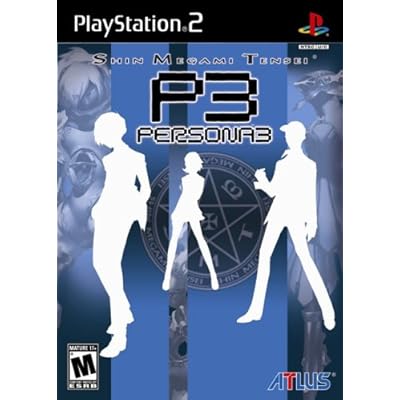
Persona 3 is a hybrid of a relationship simulator and a dungeon crawler. It's an effort at taking the grind of an average jRPG and making it significant to the audience, primarily with NPC interactions. More on this later. Your character is a typical high school student in Japan, except for being charged with saving the world through supernatural powers from demonic creatures who only come out at night. Very few people share this ability, but conveniently, you all go to the same high school.
Every dungeon is randomly-generated, though battles do not occur randomly. There's still a world map and a battle screen. Enemies are represented through what appears to be a gooey blob, whose size and color indicate the relative strength of your foe.
If you engage an enemy on the world map first, you attack first, and vice versa.
The action is turn-based. You control your protagonist and give vague commands to your other three interchangeable party members, who are able to competently assist most of the time. There are occasional questionable or repetitive actions by your party members, though they learn from trial and error... until you have to restart a particularly difficulty battle - of which there are plenty.
The difficulty of the game lies in the enemy strengths and weaknesses. Other than old-school memorization of what works and what doesn't, you have to rely on a supporting NPC with psychic abilities to figure out their stats. This can take a few turns, and will leave you and your party struggling in the meantime. The turn based system gets more interesting when you discover that you can add turns if you attack an enemy's weak point, but only once per enemy. Using this method, you can conceivably have five turns in a row. The catch is that your enemies can also gain a turn by hitting your own weak point.
So, what's your weak point?
It's entirely governed by your Persona - physical manifestations of your protagonist that gives you your occult powers. You can collect a limited number of these evil Pokemon through discovery after battles. To maximize your collection, you need to fuse multiple Persona together between battles to create new iterations. You need to be conscience of each one's weaknesses and strengths to succeed. You are rewarded for choosing the right Persona, and punished for choosing poorly. The Shin Megami Tensei series seriously punishes sloppy strategy - a rarity in modern video games. The Persona series is considered the easiest, but it still requires that you save outside of the dungeons every chance you get. The game is not shy about instantly killing you - and I'm not even referring to the bosses.
Uninspired dungeons and reskinned enemies don't harm the game enough to counter great voice acting and an in-depth battle system, fortunately. Though, like with most games of the genre, you will tire of the repetitive victory salutes of your party.
The ultimate potential of your newly-fused Persona are linked to a whole different aspect of the game - the ordinary, teenage life of your protagonist.
In this portion of the game sandwiched in between dungeon crawling, you are tasked with maintaining academic, courageous, and charismatic attributes which are required to achieve social links with your school peers, be it male or female. Raising your attributes can involve passing tests, drinking coffee, or eating at a particular restaurant. The social links, in turn, add direct experience to corresponding types of Persona you may fuse. NPC's are consequently given more significance than most of this game's peers.
The social portion of the game plays out semi-randomly; there are periodic scripted events from plot points to pop quizzes, but what you do to advance remains up to you.
Herein lies what makes Persona 3 a unique experience; a setting you can relate to. The protagonist starts out a high school academic with a penchant for girls trying to make some friends and have some fun. The intended audience for this game most likely was or is something like this. That makes the jump from this setting to the dark, occult mysteries and half-baked science fiction far more palatable than most jRPGs could ever hope to achieve.
Persona 3 takes actual role-playing back to the forefront of Japanese role-playing video games; something that has been sorely lacking. The genre has always been somewhat limited by the 1's and 0's that were used to translate the table-top games pioneered by Gary Gygax, but the technological limitations have been waning for decades. Persona 3 goes a long way towards opening up the genre to malleable games with player input on how they want to get to the end of the story. The battle systems of jRPG's of the past and present have been packed between rigid stories with unimpressive side quests and minigames that don't immerse the audience. Persona 3 manages to challenge the limitations of the hardware it's confined to quite successfully.
There are jRPG's with more tactical battle systems (Magna Carta) and more epic stories (Final Fantasy VII), but few have succeeded at being this relatable.
Every fan of the genre should give this game a chance.




