I would use rubbing alcohol and a toothbrush. Try to get a 90-something percent alcohol though rather than the regular 70-something percent. The 7X% would be fine to use, but the 9X% will be able to eat through dirt, grim, corrosion, whatever a little easier.
Another thing, now that I'm looking at the pics again, it looks like you might have a few cold solder joints. I would suggest desoldering everything, then clean the entire board (whatever corrosion from the old caps is on there, then clean all the solder pads for the caps) and then resolder the caps.
The solder diameter, hmm, you know, I really don't ever pay attention to the actual number. I just go by what I think looks good. Let me go see if it's marked on the solder I have now...
:: Runs up and down two flights of stairs::
I use .062" and .032" diameter solder. The .062" I use for almost everything. Most DIP components, potentiometers, etc. The .032" I'll break out when I don't wanna over use the solder. Some DIP components, surface mounted stuff, etc.
The .062" will be impossible to use just a little bit in some situations. Just impossible. The .032" is VERY small when you see it in person. They have lots of sizes, slightly smaller and larger. The smaller the diameter, the more control you'll have over how much you're applying.
Yet Another Sega Game Gear Capacitor Thread

Re: Yet Another Sega Game Gear Capacitor Thread
Thanks for running up and down two flights of stairs for me Ziggy587  , but more importantly thanks for the info!
, but more importantly thanks for the info! Retro Game On's YouTube Channel << Featuring reviews, features and repair videos.

Re: Yet Another Sega Game Gear Capacitor Thread
*sigh*
This topic makes me not want to fuck with my Game Gear... This sort of thing would drive me crazy.
I hope you're able to get it working without any more trouble Brik!
This topic makes me not want to fuck with my Game Gear... This sort of thing would drive me crazy.
I hope you're able to get it working without any more trouble Brik!
GameSack wrote:That's right, only Sega had the skill to make a proper Nintendo game.
Re: Yet Another Sega Game Gear Capacitor Thread
Thanks CFFJR. I do have next to nothing soldering experience though, if I had the patience to practice a bit more I might have got it right the first time 
Retro Game On's YouTube Channel << Featuring reviews, features and repair videos.

Re: Yet Another Sega Game Gear Capacitor Thread
I think I'm using .015" solder. It's probably smaller than I need, but my soldering work has been pretty clean so far, so I have no complaints.
We all have to learn somewhere though. I'm pretty new to all this too BTW.
I actually think that the Game Gear is a good first project to cut your teeth on. It's got enough room to work with (except for that damn sound cap, that one gives me a little more trouble from the tight space).
We all have to learn somewhere though. I'm pretty new to all this too BTW.
I actually think that the Game Gear is a good first project to cut your teeth on. It's got enough room to work with (except for that damn sound cap, that one gives me a little more trouble from the tight space).
...just another lost soul...
-
Purkeynator
- 64-bit
- Posts: 453
- Joined: Mon Mar 01, 2010 11:56 pm
Re: Yet Another Sega Game Gear Capacitor Thread
Plus if you totally botch it, its not like Game Gears are expensive to replace.nightrnr wrote:I actually think that the Game Gear is a good first project to cut your teeth on.

Re: Yet Another Sega Game Gear Capacitor Thread
Capacitor Check
I wonder if the new capacitors are a good match to the original ones. Not by appearance but internal surge and holding power ratings. The original ones might still be good. There is a way to verify them.
I see a lot of suggestions of repairing consoles by changing the capacitors. Usually the last thing that can go bad. Contacts on cables and carts as well as dirty discs and laser eyes should be looked at first. But if you do want to verify a capacitor, you can use an OHM meter. The capacitor will have to be discharged and desoldered from the PCB first.
I wonder if the new capacitors are a good match to the original ones. Not by appearance but internal surge and holding power ratings. The original ones might still be good. There is a way to verify them.
I see a lot of suggestions of repairing consoles by changing the capacitors. Usually the last thing that can go bad. Contacts on cables and carts as well as dirty discs and laser eyes should be looked at first. But if you do want to verify a capacitor, you can use an OHM meter. The capacitor will have to be discharged and desoldered from the PCB first.
http://www.applianceaid.com/micro4.html
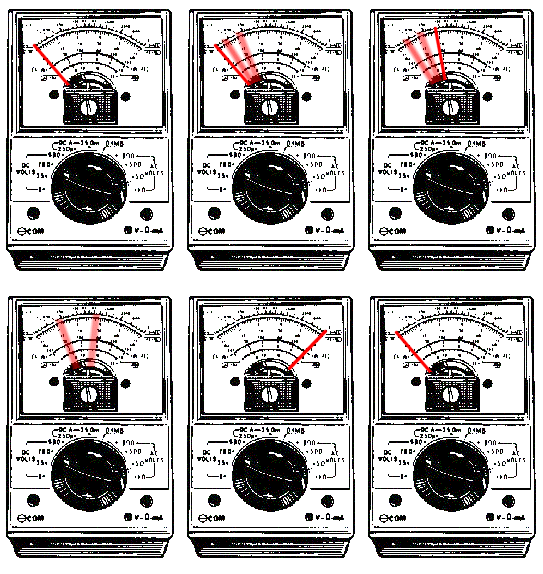
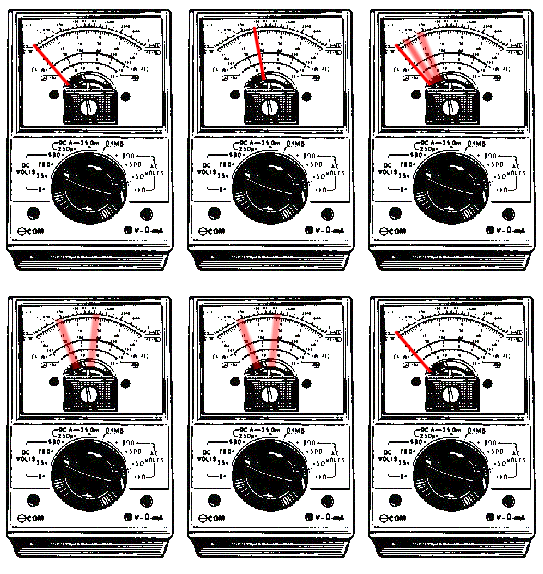
With wires off of the capacitor ( write down where they go first! )...touch the cap terminals ( red lead on left and black lead on right )...the needle should move away from the infinity ( probably left side ) and move slightly ( towards the right side ) and go back to infinity...reverse leads and ( red lead on right side and black lead on the left side ) on the cap and the needle should move away from infinity even further and then go back to infinity = a good cap. ( note - some caps have a built in resistor that you may read )
(refresh page will start the animate picture again)
If the meter needle goes all the way over to the right side and stays there = a shorted capacitor. ( refresh page will start the animate picture again)
CRT vs LCD - Hardware Mods - HDAdvance - Custom Controllers - Game Storage - Wii Gamecube and other Guides:
CRTGAMER Guides in Board Guides Index: http://www.racketboy.com/forum/viewtopi ... 5#p1109425
-
Hobie-wan

- Next-Gen
- Posts: 21705
- Joined: Sat Aug 15, 2009 8:28 pm
- Location: Under a pile of retro stuff in H-town
- Contact:
Re: Yet Another Sega Game Gear Capacitor Thread
No point in trying to reuse the old ones since they're either going to be bad or dying. Even if one has a multimeter, it might not have a capacitor tester function. However Brik said he bought a kit, so it should have had all the right bits. Remember for caps, the capacitance is important, but the voltage is simply how much it can handle. So using a 5 volt 100 µf in place of a 3 volt µf is fine.
My solder that I use for fixing stuff is 'light duty' 60/40 (tin to lead ratio) rosin core solder that's 0.32 diameter.
My solder that I use for fixing stuff is 'light duty' 60/40 (tin to lead ratio) rosin core solder that's 0.32 diameter.
I've never met a pun I didn't like. - Stark
My trade, sale and services - Rough want list - Shipping weight reference chart - AC Power Adapter reference list
My trade, sale and services - Rough want list - Shipping weight reference chart - AC Power Adapter reference list
Re: Yet Another Sega Game Gear Capacitor Thread
Apparently Sega fitted all Game Gears with bad caps that would only have a lifespan of 20 years or so. Quite a few of the ones I replaced had burst with the others probably not too far behind.
I don't have a multimeter anyway but that tactic would probably be okay to use with other console if they weren't fitted with bad caps in the first place.
I don't have a multimeter anyway but that tactic would probably be okay to use with other console if they weren't fitted with bad caps in the first place.
Retro Game On's YouTube Channel << Featuring reviews, features and repair videos.
Re: Yet Another Sega Game Gear Capacitor Thread
Say, are there any game gear mods out there to replace the screen?
GameSack wrote:That's right, only Sega had the skill to make a proper Nintendo game.