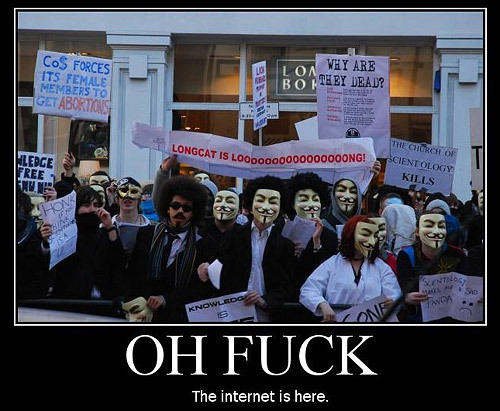
Here's a handout I used to give my classes when discussing hacktivism. Learn it and stop throwing around terms or you will make me cry.
Basic Questions
*What is hacktivism?
A couple of useful definitions, taken from The Jargon File (http://catb.org/~esr/jargon/)
Hacker: 1. A person who enjoys exploring the details of programmable systems and how to stretch their capabilities, as opposed to most users, who prefer to learn only the minimum necessary. 2. One who programs enthusiastically (even obsessively) or who enjoys programming rather than just theorizing about programming….7. One who enjoys the intellectual challenge of creatively overcoming or circumventing limitations.
Cracker: One who breaks security on a system. Coined ca. 1985 by hackers in defense against journalistic misuse of hacker.... An earlier attempt to establish worm in this sense around 1981--82 on Usenet was largely a failure.
Hacker Ethic: 1. The belief that information-sharing is a powerful positive good, and that it is an ethical duty of hackers to share their expertise by writing open-source code and facilitating access to information and to computing resources wherever possible. 2. The belief that system-cracking for fun and exploration is ethically OK as long as the cracker commits no theft, vandalism, or breach of confidentiality.
To this last definition, Steven Levy would add in his Hackers: Heroes of the Computer Revolution (1994), that the hacker ethic believes that “access to computers should be unlimited and total…all information should be free…mistrust authority - promote decentralization… hackers should be judged by their hacking not bogus criteria such as degrees, age, race, or position…you create art and beauty on a computer…computers can change your life for the better” (40-49).
It is necessary to understand these basic three definitions before beginning to grasp “hacktivism” (a word significantly not included in The Jargon File):
Hacktivism: A word formed by combining “hacking” and “activism”. It is usually loosely defined as “politically motivated hacking”, though it has recently been dubbed by one of the founding Hacktivismo members as “using technology to improve human rights across electronic media.” (http://www.cultdeadcow.com/cDc_files/cDc-0384.html). In addition, Tim Jordan, in Activism!: Direct Action, Hacktivism, and The Future of Society (2002) explains two strands of hacktivists: those who work in conjunction with others (other hackers, other movements, other companies) and those who work alone (usually hidden and anonymous).
Hacking/Hacktivism Taxonomy:
Types of Hacktivists
Individual Virtual Direct Action – one individual engaging in activist protest through the exploitation of digital technology; not necessarily a hacker.
Mass Virtual Direct Action – coordinated actions of many to engage in activist protest through the exploitation of digital technologies; not all “hackers”
Digitally Correct – hacktivism that addresses techno political concerns with hacking technology; requires knowledge of hacking
Digitally Incorrect – “Black Hat hacking” hacktivism that is always illegal - cracking; requires knowledge of hacking or how to use legal hacking tools to do illegal things.
Types of Hacktivism
Human Rights – aimed at intersection of human rights violations and information technology; frees information, not destructive, not always legal; MVDA or DI
Civil Disobedience – aimed at use of information technology by non–techno political interests; blocks or frees information, illegal but doesn’t cause permanent destruction; usually MVDA
Rioting – aimed at intersection of the use of information technology by non-techno political interests; blocks or frees information by causing destruction and disruption; illegal and causes permanent destruction; usually DI
Graffiti – aimed at any number of political interests; legality varies dependent on site. Usually individual or small group. Meant not to do any kind of permanent harm. Works in legal gray area.