History Channel ran back to back episodes today. A good series except for analogy overkill. One episode talked about current space probes, made me think of the furthest distant probes launched in the late 70s. Remember all those Time and Newsweek magazine planet flyby pics years ago? Amazing like you were there, almost could reach out and touch Neptune.
The Deep Space Probes Voyager 1 and 2
Also the
Pioneer Spacecraft that flew beyond our Solar System.
A small piece to ensure man's immortality. Billions of years from now, when earth is gone maybe these 1970's spacecraft will still be drifting, waiting to be discovered.
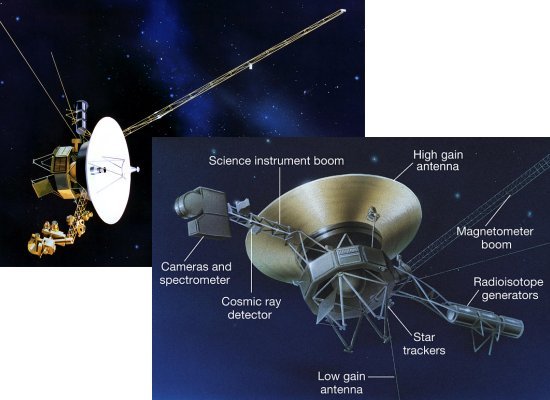
A couple of very unique items of Human's legacy are in the probes.
Earth's greeting to the Universe
Sounds and pics encoded in the disc.
http://voyager.jpl.nasa.gov/spacecraft/goldenrec.html
http://www.backata.com/index.php?newsid=801

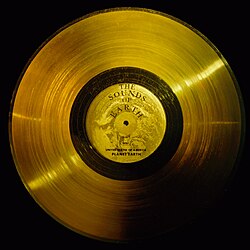

On board each Voyager spacecraft is a time capsule: a 12-inch, gold-plated copper disk carrying spoken greetings in 55 languages from Earth’s peoples, along with 115 images and myriad sounds representing our home planet. Selected for NASA by Carl Sagan and others, and produced by science writer Timothy Ferris, the disks are essentially a “greatest hits” package portraying the biodiversity of Earth and the diversity of human cultures. From the Golden Gate to the Great Wall, Beethoven to Chuck Berry, from mountain breezes to crashing surf, a dog’s howl and a baby’s cry, the disks may someday serve as “letters of introduction” to a passing extraterrestrial civilization that may stop and inspect the robots and become inquisitive about their place of origin.
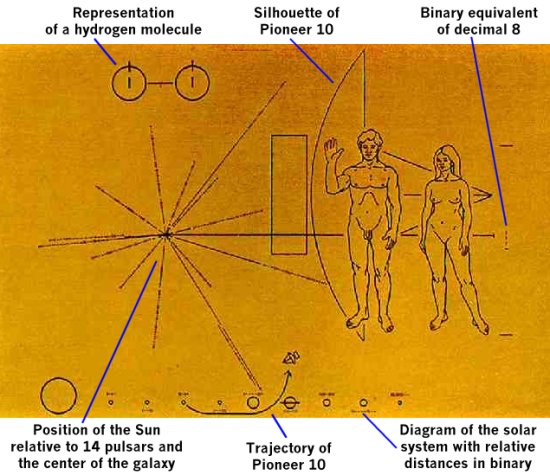
Plaque showing home planet
Affixed to
Pioneer 10 and 11.
http://en.wikipedia.org/wiki/Pioneer_plaque
 Current Status
http://en.wikipedia.org/wiki/Voyager_program
http://en.wikipedia.org/wiki/Voyager_1
http://en.wikipedia.org/wiki/Voyager_2
Current Status
http://en.wikipedia.org/wiki/Voyager_program
http://en.wikipedia.org/wiki/Voyager_1
http://en.wikipedia.org/wiki/Voyager_2
As of July 27, 2010, Voyager 1 was about 113.478 AU (16.976 billion km, or 10.549 billion miles) or 0.002 of a light-year from the Sun. (To compare, the trinary star system Alpha Centauri is 277,600.00 AU from our Sun) Voyager 1's current relative velocity is 17.07 km/s, or 61,452 kilometres per hour (38,185 mph). This calculates as 3.6 AU per year, about 10% faster than Voyager 2. NASA extrapolated the location and heliocentric coordinates of both Voyager space probes up to 2015. On November 19, 2015, Voyager 1 will be approximately 133.15 Astronomical Units from the Sun. Voyager 1 is not heading towards any particular star, but in about 40,000 years it will pass within 1.6 light years of the star AC+79 3888 in the constellation Camelopardalis because AC+79 3888 is generally moving towards our Solar System at about 119 kilometers per second.
Voyager 2 is currently transmitting scientific data at about 160 bits per second. As of August 2010, Voyager 2 is 93 AU from the Sun, at −55.32° declination and 19.785 h right ascension, placing it in the constellation Telescopium as observed from Earth.
 http://www.nasa.gov/centers/glenn/techn ... es_prt.htm
The Voyager spacecraft left the solar system at 37,000 miles per hour. At that speed, it would take Voyager 80,000 years to reach Proxima Centauri.
A thought, Do we want to let a superior civilization find us?
Would we be recognized as an intelligent species or considered as we do the ant?