1. Ninja Gaiden Ragebound (Switch)
2. Metroid Prime 4 (Switch)
3. Darkwing Duck (Gameboy)
3. DuckTales (Gameboy)
4. DuckTales 2 (Gameboy)
5. Wonder Boy in Monster Land (Sega Master System)
6. Aerial_Knight’s Never Yield (Switch)
7. Depths of Sanity (Switch)
8. Dandara: Trials of Fear Edition (Switch)
Dandara, the last game I played for Black History Month, is very well-designed metroidvania with a unique movement system. Specifically, there is no gravity, and you can’t walk, run, or jump. Rather, you flit between opposite surfaces almost instantaneously by aiming a cursor and pressing a button. This dynamic movement system, originally designed for tablets and smartphones, is both exhilarating - you can catapult through the game’s corridors at breathtaking speed - and frustrating in its limitations - if there’s no place to land, you’re stuck! Regardless, it makes for incredibly interesting world design and navigation as passages flip and rotate around you without a clear sense of “up” or “down”.
The combat is also solid. The cursor you use to aim your jumps also aims your weapon, which is a small burst of light (kind of like a short range shotgun blast). You can upgrade you base weapon to increase its range, and you get additional weapons as you proceed through the game. Knowing how to use each of these weapons effectively is critical to navigating the game’s frequent, and frequently challenging, combat.
(Also, the game has faux 16-bit graphics and sound, and it looks and sounds great. Only the true final boss, which is 3D rendered breaks this aesthetic.)
Finally, the game adopts a soulslike leveling system, where you collect EXP from enemies, but lose it all if you fall in combat. You can, of course, recover your lost EXP is you return to where you fell, and you can level up your stats at campsites. This leveling system felt a bit unnecessary to me, and I’m not sure it added much to the game, frankly, but so many games use it now that I’ve had to become accustomed to it. (Thanks, FromSoftware…)
The game was originally 7-10 hours, but the Trials of Fear expansion, by adding a “dark” world, new challenges and new bosses, adds 6-8 hours of gameplay. (It took me just under 16 hours to achieve 100% completion.) The game’s challenges are mostly manageable, and I appreciated that on more than one occasion: (1) I didn’t know where to go; and (2) there were half a dozen unexplored areas available to me. The game also discourages you from taking the “wrong” path the old-fashioned way…by making the game harder, but not impossible, and looking at a speedrun online, it’s obvious you can sequence break if that’s your thing.
On word of warning for anyone considering this unique game…the true final boss, Tormenta, is insanely tough. Right up there with the hardest bosses in Hollow Knight or Silksong. (The developers, apparently, wanted something that’d be challenging even after hundreds of hours of play testing.) Accordingly, there is an extreme difficulty spike at the very end of the game that may be off putting to some players. I loved it, but it apparently really soured some people on the experience. Accordingly, I recommend looking it up before you dump 10+ hours into the game just so you know what you’re in for.
Regardless of a few qualms, I really, really like Dandara, and it was great to play the rare game featuring a black female protagonist. I recommend it, and if any of you have beaten it, I’d be interested in your thoughts on it too.
Games Beaten 2026
-
prfsnl_gmr

- Next-Gen
- Posts: 12420
- Joined: Mon Jun 01, 2009 10:26 pm
- Location: Charlotte, North Carolina
-
ElkinFencer10

- Next-Gen
- Posts: 8986
- Joined: Fri Aug 13, 2010 8:34 pm
- Location: Elkin, North Carolina
- Contact:
Re: Games Beaten 2026
This might be my longest review to date. I had such a blast with this game and its mechanics and had a lot to say. Flake and I spent like a week and a half texting each other about our misadventures in the Delta Quadrant.
Games Beaten in 2026 - 4
* denotes a replay
January (2 Games Beaten)
February (1 Game Beaten)
March (1 Game Beaten)
4. Star Trek: Voyager - Across the Unknown - Switch 2 - March 2

Star Trek has always been one of my favorite entertainment franchises. I was literally raised on Star Trek; I was watching The Next Generation with my mom when I was two years old, and my elementary school nights always consisted of watching Voyager in bed at 10 pm on UPN-48 as I went to sleep. My middle school days were filled with - in addition to Runescape - LAN games of Star Trek Armada and Star Trek Armada 2 and online matches of Star Trek Bridge Crew and Star Trek Voyager Elite Force. And then, in the mid-2000s, Star Trek gaming just sort of...died off. We got a few games - the super okay Star Trek Legacy, the painfully generic game simply titled “Star Trek” and based on the JJ Abrams abomination, and most recently Star Trek Resurgence which is actually a really solid choice-based adventure game. But other than Resurgence, nothing has really felt like it captured the spirit of Star Trek in the past twenty years. That changed when Star Trek: Voyager - Across the Unknown dropped in February 2026. This budget price indie game - $40 for the base game or $50 for the deluxe edition that includes DLC adding a few new missions and two new recruitable heroes - perfectly captures the feel not only of Star Trek generally but of Voyager specifically in a way that not even Elite Force’s single player campaign really did.

Across the Unknown is a semi-roguelite adventure/management sim. You guide Voyager and her crew through the seven-season series' most iconic missions and encounters - with Tim Russ and Robert Duncan McNeil reprising their roles as Tuvok and Tom Paris, respectively - and your choices dramatically impact your gameplay and which ending you get. There’s one ending - the first one I got - that has Voyager return to Earth, thus completing the game, in like ten minutes. There’s also an ending that takes you right up to events of the series finale in season seven and can easily take fifteen hours to get. What makes the game so compelling despite having relatively simple gameplay once you get a feel for resource management is that it provides players a chance to ask “What if?” questions about decisions Janeway made. What if Janeway had used the Caretaker array to send Voyager back home in the first episode instead of destroying it to save the Ocampa? What if Janeway had chosen not to ally with the Borg against Species 8472 in the two-part episode, Scorpion (the best episode in the entire series in my opinion)? You get to make different choices in those pivotal moments than Captain Janeway did in the series. The consequences of those choices might end your game, for good or ill, right then and there. They might come back to haunt you - or help you - five hours later. That’s a kind of agency that Resurgence first gave Star Trek players but that Across the Unknown applies to established canon events, something that I find infinitely compelling and that adds an enormous amount of replay value.

The “semi-roguelite” aspect comes into play with the star systems in each sector and available resources. The planets you can visit and what resources they have to harvest are procedurally generated and different in each playthrough. The gameplay is largely split into three parts. The part you’ll spend the most mental energy on is the management sim aspect. When Voyager is thrown 75,000 light-years away into the Delta Quadrant by the Caretaker, the ship is left an absolute wreck. Most of the ship has lost life support (in the game specifically; it wasn’t quite that catastrophic in the show), and you have to spend your precious scarce resources repairing the ship deck by deck, starting with life support and then clearing out debris from ruined rooms. Be careful, though; all rooms have an energy cost, and if you exceed the amount of energy you have, rooms will automatically shut down which can have disastrous consequences on your defenses and crew morale. You have to make sure that you’re upgrading your warp core so that you can increase the power level. The warp core can be upgraded up to level six, but that requires research which is done in a science lab. The more science labs you have, the faster you accrue research points. You also need deuterium to power the warp core, and this is arguably the most important resource in the game; it’s an instant game over if you run out of deuterium because without it, your engines can’t take you to new planets to harvest more. You’ll also need to manage your food. The three ways to feed your crew is with emergency rations which doesn’t use a resource but gives a huge hit to morale, standard rations which uses food and keeps your morale pretty stable, and replicator rations which uses deuterium but gives a good boost to morale. That can be a precarious balance because having no morale for too long is game over, but running out of deuterium - also a game over - happens a lot faster if you’re using replicator rations to boost morale.

The other resources you’ll need, in order from most commonly used to least commonly used, are duranium used for repairs as well as crafting and building and upgrading rooms, tritanium used for room construction and research, bio-gel packs used for upgrading rooms, Borg nanites used for researching Borg technology as well as building and upgrading Borg rooms, and dilithum used for warp jumps and research. It can be difficult to juggle all of these resources, especially bio-gel packs and Borg nanites which have to be crafted with a specific room rather than harvested from planets and encounters, but it’s crucial for success. You also have to juggle crew size - if you don’t have enough crew members, you can’t operate all of your rooms - crew morale, science points for research, and food, but those are more obvious. What you’ll come to find is that the biggest limiter isn’t the resources to build and upgrade but the space on the ship for rooms. You need cargo bays to have enough storage capacity to stockpile resources (especially food and deuterium). You need crew quarters to house your crew; emergency quarters hurt morale but house a lot of people, officer quarters don’t house many but boost morale, and crew quarters fall right in the middle. Using all emergency quarters will save you space on the ship, but using all officer quarters will give you a big morale boost. You’ll need a hydroponics bay to produce food and a bio lab to produce bio-gel packs and Borg nanites. You’ll want additional combat rooms - phaser control rooms, torpedo control rooms, shield arrays, disrupter control rooms, and Borg cutting beam control rooms - to increase your combat prowess. You’ll want batteries to store excess energy which can be used if you run low on deuterium. You’ll want engineering offices to repair the ship and build rooms, and you’ll want science labs to get more research points.

Having spent FAR too much time on the management sim part of the gameplay, let’s finally move on. The second part of gameplay is the in-system travel and exploration where you’ll scan planets for harvestable resources and complete main and side missions. Side missions are extremely easy to miss depending on choices you make; I automatically failed one side mission because of the very first choice I made for it. This adds a bit of uniqueness to each playthrough, though, so I actually don’t mind that at all. A lot of these missions will involve flying between planets or between systems in a sector, but sometimes you’ll have to send your heroes (the named characters from the show) on away missions. These are essentially like the old text-based adventure games where it tells you what’s happening and you have to make a choice of how to deal with it. Depending on what three heroes you choose, these missions could be easy or brutal. Each hero has a specialized trait - Tom Paris has the “Pilot” trait, for example, and Chakotay has “Survivalist” - and these are sometimes necessary to select a certain choice. Sometimes it’s based on species; you’ll need Neelix or Kes on the team if you want to select a choice that requires Talaxian or Ocampa, respectively. Most choices, though, are based on skills - engineering, combat, science, medicine, diplomacy, and...whatever the Starfleet icon represents. I don’t remember what that’s supposed to be. Starfleetness, I guess. If your skill is high enough (sometimes you can have two characters pool their points in a certain skill to reach a pass threshold), you’ll be guaranteed success. If your skill level exceeds the necessary level, you’ll have a chance of critical success which yields additional resources. If your skill is below that level, you’ll still have a chance of success, but the more the task level exceeds your hero’s skill level, the greater the risk of failure is. Failure sometimes means a bad outcome for the mission, it sometimes means an injury for a hero, and sometimes it means a hero’s death.

The final part of the gameplay - the least common part but the most exciting - is combat. When you’re in combat, whether it’s a random ambush or a scripted battle, you’ll be taken to a screen where you see Voyager from a third person perspective and the ship or ships you’re fighting. This doesn’t play like a flight combat sim, though; you’ll select a specific part of the enemy ship to attack, and your ship will automatically fly to aim at that part with phasers, disruptors, and Borg cutting beams firing automatically. Their fire rates depend on how many control rooms you have, what level they are, and if you have heroes assigned to them to boost their effectiveness. Photon torpedoes are fired manually with L2, and you can choose three heroes to “equip” for lack of a better word before each battle, each with their own ability. My favorite selection was Tuvok for his phaser burst ability, Chakotay for his maneuverability and damage boost ability, and a character I won’t name to avoid potential spoilers for their stackable ability to boosts weapon damage. I ended up having Voyager so overpowered that I destroyed the Borg Queen’s tactical cube at the every end of the final sector without ever having my shields drop. Having more control rooms to boost your power means that you divert more power to that particular system (whether it’s a weapon or shields). Energy is manually allocated in combat, and you can take power away from one system and divert it to another up to that system’s maximum; this maximum can be increased by building more control rooms. For example, I had so much shield power from my three shield generators that except for the final fight, I ended up taking a lot of energy away from my shields and putting it into my phasers and disruptors. If your enemy’s shields are down but has a lot of hull strength, you could take power away from phasers - which are most effective for draining shields - and divert it to your Borg cutting beams if you’ve built any which do very little to shields but are devastating against an unshielded hull.

Visually, the game looks like you’d expect for an indie game in a relatively niche IP; it looks fairly good, but it’s not going to impress anyone. Sound design is great, though. The ambient sounds of the warp core when you’re in the ship view perfectly captures the feel of a starship, and the phaser and photon torpedo sound effects are perfect. The character models look a little off - I don’t know how else to describe it - but not to the point where you’ll ever have trouble recognizing a character from the show. This is definitely an example of placing function over form; the game may not have dazzling graphics and full voice acting, but the gameplay is addictive and fun, and the game has a ton of replay value given all of the branching paths and certain degree of RNG luck.

Star Trek: Voyager - Across the Unknown is the ultimate love letter to Voyager fans. It manages to stay faithful to the ship’s encounters in the show while taking enough creative liberty to make the choices significant and impactful even when they divert from what Captain Janeway chose to do in the show. Even if you’ve seen the entire Voyager series numerous times like I have, there’s still something new to experience here depending on your choices. It definitely looks like an indie game, and the relatively slow pace of the game fits in with a lot of indie games, but the quality of the narrative choices - especially if you’re a fan of Voyager - far surpassed what I expected from an indie game, and the price tag is fair for an indie game lacking the polish and pizazz of a AAA title. If you’re a Star Trek fan, you absolutely must download this game. If you’re a general sci-fi fan or just like a good story where you choices change the ending, you should at least check out the game to see if it’s something you’d enjoy enough to buy. Either way, this game might not be a masterpiece, but it’s the kind of Star Trek game many of us have been craving for decades.
Games Beaten in 2026 - 4
* denotes a replay
January (2 Games Beaten)
Star Trek has always been one of my favorite entertainment franchises. I was literally raised on Star Trek; I was watching The Next Generation with my mom when I was two years old, and my elementary school nights always consisted of watching Voyager in bed at 10 pm on UPN-48 as I went to sleep. My middle school days were filled with - in addition to Runescape - LAN games of Star Trek Armada and Star Trek Armada 2 and online matches of Star Trek Bridge Crew and Star Trek Voyager Elite Force. And then, in the mid-2000s, Star Trek gaming just sort of...died off. We got a few games - the super okay Star Trek Legacy, the painfully generic game simply titled “Star Trek” and based on the JJ Abrams abomination, and most recently Star Trek Resurgence which is actually a really solid choice-based adventure game. But other than Resurgence, nothing has really felt like it captured the spirit of Star Trek in the past twenty years. That changed when Star Trek: Voyager - Across the Unknown dropped in February 2026. This budget price indie game - $40 for the base game or $50 for the deluxe edition that includes DLC adding a few new missions and two new recruitable heroes - perfectly captures the feel not only of Star Trek generally but of Voyager specifically in a way that not even Elite Force’s single player campaign really did.
Across the Unknown is a semi-roguelite adventure/management sim. You guide Voyager and her crew through the seven-season series' most iconic missions and encounters - with Tim Russ and Robert Duncan McNeil reprising their roles as Tuvok and Tom Paris, respectively - and your choices dramatically impact your gameplay and which ending you get. There’s one ending - the first one I got - that has Voyager return to Earth, thus completing the game, in like ten minutes. There’s also an ending that takes you right up to events of the series finale in season seven and can easily take fifteen hours to get. What makes the game so compelling despite having relatively simple gameplay once you get a feel for resource management is that it provides players a chance to ask “What if?” questions about decisions Janeway made. What if Janeway had used the Caretaker array to send Voyager back home in the first episode instead of destroying it to save the Ocampa? What if Janeway had chosen not to ally with the Borg against Species 8472 in the two-part episode, Scorpion (the best episode in the entire series in my opinion)? You get to make different choices in those pivotal moments than Captain Janeway did in the series. The consequences of those choices might end your game, for good or ill, right then and there. They might come back to haunt you - or help you - five hours later. That’s a kind of agency that Resurgence first gave Star Trek players but that Across the Unknown applies to established canon events, something that I find infinitely compelling and that adds an enormous amount of replay value.
The “semi-roguelite” aspect comes into play with the star systems in each sector and available resources. The planets you can visit and what resources they have to harvest are procedurally generated and different in each playthrough. The gameplay is largely split into three parts. The part you’ll spend the most mental energy on is the management sim aspect. When Voyager is thrown 75,000 light-years away into the Delta Quadrant by the Caretaker, the ship is left an absolute wreck. Most of the ship has lost life support (in the game specifically; it wasn’t quite that catastrophic in the show), and you have to spend your precious scarce resources repairing the ship deck by deck, starting with life support and then clearing out debris from ruined rooms. Be careful, though; all rooms have an energy cost, and if you exceed the amount of energy you have, rooms will automatically shut down which can have disastrous consequences on your defenses and crew morale. You have to make sure that you’re upgrading your warp core so that you can increase the power level. The warp core can be upgraded up to level six, but that requires research which is done in a science lab. The more science labs you have, the faster you accrue research points. You also need deuterium to power the warp core, and this is arguably the most important resource in the game; it’s an instant game over if you run out of deuterium because without it, your engines can’t take you to new planets to harvest more. You’ll also need to manage your food. The three ways to feed your crew is with emergency rations which doesn’t use a resource but gives a huge hit to morale, standard rations which uses food and keeps your morale pretty stable, and replicator rations which uses deuterium but gives a good boost to morale. That can be a precarious balance because having no morale for too long is game over, but running out of deuterium - also a game over - happens a lot faster if you’re using replicator rations to boost morale.
The other resources you’ll need, in order from most commonly used to least commonly used, are duranium used for repairs as well as crafting and building and upgrading rooms, tritanium used for room construction and research, bio-gel packs used for upgrading rooms, Borg nanites used for researching Borg technology as well as building and upgrading Borg rooms, and dilithum used for warp jumps and research. It can be difficult to juggle all of these resources, especially bio-gel packs and Borg nanites which have to be crafted with a specific room rather than harvested from planets and encounters, but it’s crucial for success. You also have to juggle crew size - if you don’t have enough crew members, you can’t operate all of your rooms - crew morale, science points for research, and food, but those are more obvious. What you’ll come to find is that the biggest limiter isn’t the resources to build and upgrade but the space on the ship for rooms. You need cargo bays to have enough storage capacity to stockpile resources (especially food and deuterium). You need crew quarters to house your crew; emergency quarters hurt morale but house a lot of people, officer quarters don’t house many but boost morale, and crew quarters fall right in the middle. Using all emergency quarters will save you space on the ship, but using all officer quarters will give you a big morale boost. You’ll need a hydroponics bay to produce food and a bio lab to produce bio-gel packs and Borg nanites. You’ll want additional combat rooms - phaser control rooms, torpedo control rooms, shield arrays, disrupter control rooms, and Borg cutting beam control rooms - to increase your combat prowess. You’ll want batteries to store excess energy which can be used if you run low on deuterium. You’ll want engineering offices to repair the ship and build rooms, and you’ll want science labs to get more research points.
Having spent FAR too much time on the management sim part of the gameplay, let’s finally move on. The second part of gameplay is the in-system travel and exploration where you’ll scan planets for harvestable resources and complete main and side missions. Side missions are extremely easy to miss depending on choices you make; I automatically failed one side mission because of the very first choice I made for it. This adds a bit of uniqueness to each playthrough, though, so I actually don’t mind that at all. A lot of these missions will involve flying between planets or between systems in a sector, but sometimes you’ll have to send your heroes (the named characters from the show) on away missions. These are essentially like the old text-based adventure games where it tells you what’s happening and you have to make a choice of how to deal with it. Depending on what three heroes you choose, these missions could be easy or brutal. Each hero has a specialized trait - Tom Paris has the “Pilot” trait, for example, and Chakotay has “Survivalist” - and these are sometimes necessary to select a certain choice. Sometimes it’s based on species; you’ll need Neelix or Kes on the team if you want to select a choice that requires Talaxian or Ocampa, respectively. Most choices, though, are based on skills - engineering, combat, science, medicine, diplomacy, and...whatever the Starfleet icon represents. I don’t remember what that’s supposed to be. Starfleetness, I guess. If your skill is high enough (sometimes you can have two characters pool their points in a certain skill to reach a pass threshold), you’ll be guaranteed success. If your skill level exceeds the necessary level, you’ll have a chance of critical success which yields additional resources. If your skill is below that level, you’ll still have a chance of success, but the more the task level exceeds your hero’s skill level, the greater the risk of failure is. Failure sometimes means a bad outcome for the mission, it sometimes means an injury for a hero, and sometimes it means a hero’s death.
The final part of the gameplay - the least common part but the most exciting - is combat. When you’re in combat, whether it’s a random ambush or a scripted battle, you’ll be taken to a screen where you see Voyager from a third person perspective and the ship or ships you’re fighting. This doesn’t play like a flight combat sim, though; you’ll select a specific part of the enemy ship to attack, and your ship will automatically fly to aim at that part with phasers, disruptors, and Borg cutting beams firing automatically. Their fire rates depend on how many control rooms you have, what level they are, and if you have heroes assigned to them to boost their effectiveness. Photon torpedoes are fired manually with L2, and you can choose three heroes to “equip” for lack of a better word before each battle, each with their own ability. My favorite selection was Tuvok for his phaser burst ability, Chakotay for his maneuverability and damage boost ability, and a character I won’t name to avoid potential spoilers for their stackable ability to boosts weapon damage. I ended up having Voyager so overpowered that I destroyed the Borg Queen’s tactical cube at the every end of the final sector without ever having my shields drop. Having more control rooms to boost your power means that you divert more power to that particular system (whether it’s a weapon or shields). Energy is manually allocated in combat, and you can take power away from one system and divert it to another up to that system’s maximum; this maximum can be increased by building more control rooms. For example, I had so much shield power from my three shield generators that except for the final fight, I ended up taking a lot of energy away from my shields and putting it into my phasers and disruptors. If your enemy’s shields are down but has a lot of hull strength, you could take power away from phasers - which are most effective for draining shields - and divert it to your Borg cutting beams if you’ve built any which do very little to shields but are devastating against an unshielded hull.
Visually, the game looks like you’d expect for an indie game in a relatively niche IP; it looks fairly good, but it’s not going to impress anyone. Sound design is great, though. The ambient sounds of the warp core when you’re in the ship view perfectly captures the feel of a starship, and the phaser and photon torpedo sound effects are perfect. The character models look a little off - I don’t know how else to describe it - but not to the point where you’ll ever have trouble recognizing a character from the show. This is definitely an example of placing function over form; the game may not have dazzling graphics and full voice acting, but the gameplay is addictive and fun, and the game has a ton of replay value given all of the branching paths and certain degree of RNG luck.
Star Trek: Voyager - Across the Unknown is the ultimate love letter to Voyager fans. It manages to stay faithful to the ship’s encounters in the show while taking enough creative liberty to make the choices significant and impactful even when they divert from what Captain Janeway chose to do in the show. Even if you’ve seen the entire Voyager series numerous times like I have, there’s still something new to experience here depending on your choices. It definitely looks like an indie game, and the relatively slow pace of the game fits in with a lot of indie games, but the quality of the narrative choices - especially if you’re a fan of Voyager - far surpassed what I expected from an indie game, and the price tag is fair for an indie game lacking the polish and pizazz of a AAA title. If you’re a Star Trek fan, you absolutely must download this game. If you’re a general sci-fi fan or just like a good story where you choices change the ending, you should at least check out the game to see if it’s something you’d enjoy enough to buy. Either way, this game might not be a masterpiece, but it’s the kind of Star Trek game many of us have been craving for decades.
Patron Saint of Bitch Mode
-
TheSSNintendo

- 128-bit
- Posts: 671
- Joined: Mon Jul 11, 2011 10:27 pm
Re: Games Beaten 2026
1. Deja Vu: MacVenture Series
2. Deja Vu II: MacVenture Series
3. Earthworm Jim 2 (SNES/Switch Online)
4. Crash Banidcoot: The Huge Adventure (Gameboy Advance)
5. Metroid Prime 4: Beyond (Switch)
6. Lego Batman: The Video Game (Steam)
7. Ys III - Wanderers from Ys (SNES)
8. Suikoden II HD Remaster (Switch)
9. Technobabylon (GOG)
10. Crystalis (NES/Switch Online)
11. Mega Man II (Game Boy/Switch Online)
2. Deja Vu II: MacVenture Series
3. Earthworm Jim 2 (SNES/Switch Online)
4. Crash Banidcoot: The Huge Adventure (Gameboy Advance)
5. Metroid Prime 4: Beyond (Switch)
6. Lego Batman: The Video Game (Steam)
7. Ys III - Wanderers from Ys (SNES)
8. Suikoden II HD Remaster (Switch)
9. Technobabylon (GOG)
10. Crystalis (NES/Switch Online)
11. Mega Man II (Game Boy/Switch Online)
-
Markies

- Next-Gen
- Posts: 1615
- Joined: Fri Mar 27, 2015 4:29 pm
- Location: St. Louis, Missouri
- Contact:
Re: Games Beaten 2026
Markies' Games Beat List Of 2026!
***Denotes Replay For Completion***
1. Mario & Luigi: Superstar Saga (GBA)
2. Knights of the Round (SNES)
3. Fight'N Rage (NS)
4. Time Stalkers (SDC)
***5. Final Fantasy X/X-2 HD Remaster (PS3)***
6. OutRunners (GEN)
***7. Midtown Madness 3 (XBOX)***
8. Phantasy Star Online: Episode I & II (GCN)

I beat Phantasy Star Online: Episode I & II on the Nintendo GameCube this evening!
Way back in 2016, I beat the original Phantasy Star Online on the Sega Dreamcast. It is an incredibly long and repetitive game, but by the end, I found it so comforting that I began to enjoy it. The Dreamcast version is much harder because of some specific quests, but I still wanted to continue with the series. In 2021, I beat Phantasy Star Online Version 2, also on the Dreamcast. That is much of same game with the same quests with only a minor few tweaks here and there. Wondering why I wanted to continue, I decided to pick up the GameCube version last year. I was going to play Evolution Worlds for the GameCube, but my New Year's Backloggery Roulette had me play Evolution 2 instead. So, I decided I would play through the GameCube version.
Much like Version 2, this is basically the same game that I played and beat over 10 years ago. It has some nice tweaks like NPC's lying on the ground for boss fights, but it is the same quests and same basic structure. I don't know why I decided to play through a long and repetitive game three separate times in 10 years is beyond me, but I know who I am. At the beginning, I was enjoying myself. The quests were enjoyable and the enemies were not too difficult. Once you have a powerful gun, it is easy to just mow down enemies left and right.
Unfortunately, that is when the grind hits and it just becomes slog. The final two areas are so long and such a jump in levels that it becomes a giant pain. Everything in the game is slow. The combat, the exploration and the unraveling of the world is just slow and is just one small step at a time. You can't take that much damage and there are so many enemies on screen that it just becomes the same battle over and over. You run to the corner, shoot them until they are in your face, run to the opposite corner and repeat the process over and over again. Add in annoying traps, a limited inventory space and a clunky targeting system and I really began to grow tired of the game by the end.
Overall, I grew to dislike Phantasy Star: Episode I & II by the end. Don't get me wrong. I think any iteration of Phantasy Star Online is good game to play in its offline mode. But, from personal experience, I would say that any iteration is completely fine. I don't think anybody needs to play it several different times. It's can also be a bit clunky, but it does have its charm.
***Denotes Replay For Completion***
1. Mario & Luigi: Superstar Saga (GBA)
2. Knights of the Round (SNES)
3. Fight'N Rage (NS)
4. Time Stalkers (SDC)
***5. Final Fantasy X/X-2 HD Remaster (PS3)***
6. OutRunners (GEN)
***7. Midtown Madness 3 (XBOX)***
8. Phantasy Star Online: Episode I & II (GCN)
I beat Phantasy Star Online: Episode I & II on the Nintendo GameCube this evening!
Way back in 2016, I beat the original Phantasy Star Online on the Sega Dreamcast. It is an incredibly long and repetitive game, but by the end, I found it so comforting that I began to enjoy it. The Dreamcast version is much harder because of some specific quests, but I still wanted to continue with the series. In 2021, I beat Phantasy Star Online Version 2, also on the Dreamcast. That is much of same game with the same quests with only a minor few tweaks here and there. Wondering why I wanted to continue, I decided to pick up the GameCube version last year. I was going to play Evolution Worlds for the GameCube, but my New Year's Backloggery Roulette had me play Evolution 2 instead. So, I decided I would play through the GameCube version.
Much like Version 2, this is basically the same game that I played and beat over 10 years ago. It has some nice tweaks like NPC's lying on the ground for boss fights, but it is the same quests and same basic structure. I don't know why I decided to play through a long and repetitive game three separate times in 10 years is beyond me, but I know who I am. At the beginning, I was enjoying myself. The quests were enjoyable and the enemies were not too difficult. Once you have a powerful gun, it is easy to just mow down enemies left and right.
Unfortunately, that is when the grind hits and it just becomes slog. The final two areas are so long and such a jump in levels that it becomes a giant pain. Everything in the game is slow. The combat, the exploration and the unraveling of the world is just slow and is just one small step at a time. You can't take that much damage and there are so many enemies on screen that it just becomes the same battle over and over. You run to the corner, shoot them until they are in your face, run to the opposite corner and repeat the process over and over again. Add in annoying traps, a limited inventory space and a clunky targeting system and I really began to grow tired of the game by the end.
Overall, I grew to dislike Phantasy Star: Episode I & II by the end. Don't get me wrong. I think any iteration of Phantasy Star Online is good game to play in its offline mode. But, from personal experience, I would say that any iteration is completely fine. I don't think anybody needs to play it several different times. It's can also be a bit clunky, but it does have its charm.

-
RobertAugustdeMeijer
- 64-bit
- Posts: 330
- Joined: Fri Sep 02, 2022 10:15 am
Re: Games Beaten 2026
15: Overcooked!
Despite it being labeled as a party game, due to its multiplayer and simple controls, the levels can be quite demanding. Still, a couple of rounds of practice and perhaps a bit of planning ahead will get you through within a couple of attempts, even the later levels. At its worst, it can be demoralizing to have to precisely steer your way over molten lava or moving islands of ice, especially considering the floaty controls. While the actual gameplay can feel like the work your simulating, there's still an amazing thrill of camaraderie when teamwork goes well. And yes, the chaos does lead to hilarious mistakes!
7/10
Despite it being labeled as a party game, due to its multiplayer and simple controls, the levels can be quite demanding. Still, a couple of rounds of practice and perhaps a bit of planning ahead will get you through within a couple of attempts, even the later levels. At its worst, it can be demoralizing to have to precisely steer your way over molten lava or moving islands of ice, especially considering the floaty controls. While the actual gameplay can feel like the work your simulating, there's still an amazing thrill of camaraderie when teamwork goes well. And yes, the chaos does lead to hilarious mistakes!
7/10
-
prfsnl_gmr
- Next-Gen
- Posts: 12420
- Joined: Mon Jun 01, 2009 10:26 pm
- Location: Charlotte, North Carolina
Re: Games Beaten 2026
Great review, @Elk. I expected you to have strong feelings on that game, and I appreciate the write up.
……
1. Ninja Gaiden Ragebound (Switch)
2. Metroid Prime 4 (Switch)
3. Darkwing Duck (Gameboy)
3. DuckTales (Gameboy)
4. DuckTales 2 (Gameboy)
5. Wonder Boy in Monster Land (Sega Master System)
6. Aerial_Knight’s Never Yield (Switch)
7. Depths of Sanity (Switch)
8. Dandara: Trials of Fear Edition (Switch)
9. Ghostrunner II (Xbox)
Ghostrunner, released in 2020, is one of my favorite games. It’s a first-person action platformer where you play as a cyborg ninja in a post-apocalyptic, cyberpunk dystopia. It moves fast, looks great, and is hard as nails. One-hit kills, extreme first-person platforming, and exceptionally well-designed battles coalesce into a sublime gaming experience. Ghostrunner is a lean, mean killing machine, and I loved every minute of its 7-10 hour running time.
Ghostrunner II keeps everything that made the first game great and adds to it. Unfortunately, it adds way, way too much, and demonstrates how, in video game design, less can be more, and more is, frequently, less. In the first game, you ran around really fast jumping off walls and slicing stuff with your sword. I think, perhaps, you got a throwing star towards the end of the game. Ghostrunner II, in contrast, introduces blocking/parrying mechanics, two new sub weapons, special “limit break” abilities, a motorcycle, and, finally, a wing suit. It also has a passive ability skill tree. The levels in Ghostrunner were linear and had a nice rhythm between platforming and combat. You get a bit of that in Ghostrunner II, but there are also some larger open, non-linear levels. That sounds cool, but since some of the signposting isn’t great, you’ll frequently find yourself wondering where to go. (Nothing makes you feel like a badass ninja more than getting lost!) Finally, Ghoarrunner’s story was l, basically, “fight way through dystopian hell scape to kill a dude.” Ghostrunner II, in contrast, has nearly a dozen characters, hours of dialogue, and a convoluted narrative seemingly more interested in establishing “lore” than telling a compelling story. (The only dialogue I really liked was with the final boss. He gets so exasperated that, by the end of the fight he’s literally just cursing you out in the student possible terms. It’s actually very funny in a “Curse you, Bayle!” sort of way.)
Don't get me wrong. Ghostrunner II is still a fine game. It still, intermittently, features some of the highs that made its predecessor so great, and there are some truly exhilarating moments. (The combat still rocks, and the boss battles are rad.) It also still looks and sounds great. Some people may also like everything the developers added to the game. In my opinion, though, it’s twice as long and twice as complex as it needs to be, and as a result, it didn’t draw me in quite like the first. I let getting distracted by other games, and I had to make a real effort to push through this one, which was definite not the case with the first game (which I played relentlessly and couldn’t put down).
If you haven’t played Ghostrunner, and you’re looking for a challenge, you should play it. If you have, and you’re looking for more Ghostrunner, you can play Ghostrunner II, but I recommend it only hesitantly to even to the most devoted fans of the series.
……
1. Ninja Gaiden Ragebound (Switch)
2. Metroid Prime 4 (Switch)
3. Darkwing Duck (Gameboy)
3. DuckTales (Gameboy)
4. DuckTales 2 (Gameboy)
5. Wonder Boy in Monster Land (Sega Master System)
6. Aerial_Knight’s Never Yield (Switch)
7. Depths of Sanity (Switch)
8. Dandara: Trials of Fear Edition (Switch)
9. Ghostrunner II (Xbox)
Ghostrunner, released in 2020, is one of my favorite games. It’s a first-person action platformer where you play as a cyborg ninja in a post-apocalyptic, cyberpunk dystopia. It moves fast, looks great, and is hard as nails. One-hit kills, extreme first-person platforming, and exceptionally well-designed battles coalesce into a sublime gaming experience. Ghostrunner is a lean, mean killing machine, and I loved every minute of its 7-10 hour running time.
Ghostrunner II keeps everything that made the first game great and adds to it. Unfortunately, it adds way, way too much, and demonstrates how, in video game design, less can be more, and more is, frequently, less. In the first game, you ran around really fast jumping off walls and slicing stuff with your sword. I think, perhaps, you got a throwing star towards the end of the game. Ghostrunner II, in contrast, introduces blocking/parrying mechanics, two new sub weapons, special “limit break” abilities, a motorcycle, and, finally, a wing suit. It also has a passive ability skill tree. The levels in Ghostrunner were linear and had a nice rhythm between platforming and combat. You get a bit of that in Ghostrunner II, but there are also some larger open, non-linear levels. That sounds cool, but since some of the signposting isn’t great, you’ll frequently find yourself wondering where to go. (Nothing makes you feel like a badass ninja more than getting lost!) Finally, Ghoarrunner’s story was l, basically, “fight way through dystopian hell scape to kill a dude.” Ghostrunner II, in contrast, has nearly a dozen characters, hours of dialogue, and a convoluted narrative seemingly more interested in establishing “lore” than telling a compelling story. (The only dialogue I really liked was with the final boss. He gets so exasperated that, by the end of the fight he’s literally just cursing you out in the student possible terms. It’s actually very funny in a “Curse you, Bayle!” sort of way.)
Don't get me wrong. Ghostrunner II is still a fine game. It still, intermittently, features some of the highs that made its predecessor so great, and there are some truly exhilarating moments. (The combat still rocks, and the boss battles are rad.) It also still looks and sounds great. Some people may also like everything the developers added to the game. In my opinion, though, it’s twice as long and twice as complex as it needs to be, and as a result, it didn’t draw me in quite like the first. I let getting distracted by other games, and I had to make a real effort to push through this one, which was definite not the case with the first game (which I played relentlessly and couldn’t put down).
If you haven’t played Ghostrunner, and you’re looking for a challenge, you should play it. If you have, and you’re looking for more Ghostrunner, you can play Ghostrunner II, but I recommend it only hesitantly to even to the most devoted fans of the series.

Re: Games Beaten 2026
...nice work getting through Dandara prfsnl, I played through it a while ago while it was on Gamepass and also found a copy for the Switch at a convention a while back. The final boss Tormenta was tough, but it definitely felt great getting it done.
-
prfsnl_gmr
- Next-Gen
- Posts: 12420
- Joined: Mon Jun 01, 2009 10:26 pm
- Location: Charlotte, North Carolina
Re: Games Beaten 2026
Thanks, Syndicate. Those are really my favorite video game moments. I start really doubtful whether I can do it - I got wrecked my first few attempts! - but a little while later, I’m pumping my fist in the air after a hard won victory. Glad to read someone else has beaten it too!
Al’s, the physical edition has beautiful cover art. Great pick up!
-
TheSSNintendo
- 128-bit
- Posts: 671
- Joined: Mon Jul 11, 2011 10:27 pm
Re: Games Beaten 2026
1. Deja Vu: MacVenture Series
2. Deja Vu II: MacVenture Series
3. Earthworm Jim 2 (SNES/Switch Online)
4. Crash Banidcoot: The Huge Adventure (Gameboy Advance)
5. Metroid Prime 4: Beyond (Switch)
6. Lego Batman: The Video Game (Steam)
7. Ys III - Wanderers from Ys (SNES)
8. Suikoden II HD Remaster (Switch)
9. Technobabylon (GOG)
10. Crystalis (NES/Switch Online)
11. Mega Man II (Game Boy/Switch Online)
12. Teenage Mutant Ninja Turtles II: Back from the Sewers (Game Boy/Cowabunga Collection)
2. Deja Vu II: MacVenture Series
3. Earthworm Jim 2 (SNES/Switch Online)
4. Crash Banidcoot: The Huge Adventure (Gameboy Advance)
5. Metroid Prime 4: Beyond (Switch)
6. Lego Batman: The Video Game (Steam)
7. Ys III - Wanderers from Ys (SNES)
8. Suikoden II HD Remaster (Switch)
9. Technobabylon (GOG)
10. Crystalis (NES/Switch Online)
11. Mega Man II (Game Boy/Switch Online)
12. Teenage Mutant Ninja Turtles II: Back from the Sewers (Game Boy/Cowabunga Collection)

Re: Games Beaten 2026
1. Dungeons & Dragons: Tower of Doom (SAT)
2. Castle Crashers Remastered (NSW)
3. Soul Calibur (DC)
4. Final Fantasy VII (PS1)
5. Alien Storm (GEN)
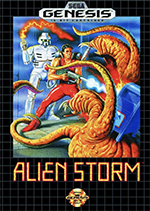
I wasn’t aware of Alien Storm when it was released in the early ‘90s, it happened to be one of those titles that I just didn’t come across or hear about through my friends or relatives. I didn’t find out about it until much later, but when I heard that the development team behind Golden Axe worked on it, I had to check it out. I ended up purchasing the game a few years back and had reached the final level before, but didn’t manage to beat it until this playthrough.
Alien Storm is a beat ‘em up with a sci-fi twist, some shooter and auto scrolling sections towards the end of stages, and some unique mechanics. You have a choice of three playable characters, Gordon, who uses a lightning gun, Karen, who has a flamethrower, and Scooter, an android with an energy whip. For this playthrough, I used Gordon. In regards to the mechanics, this beat ‘em up plays a bit different than your standard game in the genre. Other than your normal attack and special attack, you have the ability to roll, which will allow you to get away from being surrounded by enemies. If you tap forward twice, you can run and if you press roll you can jump forward. However, you don’t have the ability to jump straight up. The roll maneuver will come in handy! You will have to fight through waves of aliens, which are sometimes hiding throughout the stages. Some of the garbage cans or mailboxes that would just be destroyed in other games for an item now pop up and turn out to be an alien enemy.
Alien Storm contains eight levels, with the levels being fairly short here. You’ll go through a beat ‘em up segment, a first-person gallery shooter section, where you can collect health items and refill your energy. Your energy bar is needed for your special attack. If you don’t have enough, you won’t be able to use it, so it’s best to save it for boss encounters or if you’re really in a jam. After some levels you'll also go through an auto scrolling section where your character is running forward and you'll need to dodge enemies and try to grab items.
Graphics wise, Alien Storm has that signature early Genesis look. The character sprites and enemies look good, but I found most of the background designs for the levels to be a little dull. There’s a lot of browns and greys used, as most of the missions take place in a town type of setting, with the later missions being in the alien headquarters. Once you reach the later missions, there’s some more colorful backdrops. Also, there’s a few cool looking bosses, but it’s disappointing that one of the bosses repeats later in the game. I think palette swaps for regular enemies is totally fine for this genre, but I’d prefer to have a unique boss after every stage. Soundtrack wise, it’s a bit of a mixed bag, IMO. There are some fun and catchy tunes here that I think fit with the theme of the game and the beat ‘em up action, but there are a few songs that don’t really do it for me. My favorite out of the bunch is probably the track titled “Cybernate-Q.”
Other than my nitpick regarding the look of some of the levels, the only criticism I have of the game is that the health items here really give you a very small refill. It's kind of a pain, as there's not too many items throughout the game, so you'll really need to be careful with the amount of damage you're taking.
Overall, Alien Storm is a fun beat ‘em up on the Genesis. If you’re a fan of the genre and have already spent a lot of time with the more popular titles on the console, this is a good one to look into. I’d like to try the Master System version sometime to compare!
2. Castle Crashers Remastered (NSW)
3. Soul Calibur (DC)
4. Final Fantasy VII (PS1)
5. Alien Storm (GEN)
I wasn’t aware of Alien Storm when it was released in the early ‘90s, it happened to be one of those titles that I just didn’t come across or hear about through my friends or relatives. I didn’t find out about it until much later, but when I heard that the development team behind Golden Axe worked on it, I had to check it out. I ended up purchasing the game a few years back and had reached the final level before, but didn’t manage to beat it until this playthrough.
Alien Storm is a beat ‘em up with a sci-fi twist, some shooter and auto scrolling sections towards the end of stages, and some unique mechanics. You have a choice of three playable characters, Gordon, who uses a lightning gun, Karen, who has a flamethrower, and Scooter, an android with an energy whip. For this playthrough, I used Gordon. In regards to the mechanics, this beat ‘em up plays a bit different than your standard game in the genre. Other than your normal attack and special attack, you have the ability to roll, which will allow you to get away from being surrounded by enemies. If you tap forward twice, you can run and if you press roll you can jump forward. However, you don’t have the ability to jump straight up. The roll maneuver will come in handy! You will have to fight through waves of aliens, which are sometimes hiding throughout the stages. Some of the garbage cans or mailboxes that would just be destroyed in other games for an item now pop up and turn out to be an alien enemy.
Alien Storm contains eight levels, with the levels being fairly short here. You’ll go through a beat ‘em up segment, a first-person gallery shooter section, where you can collect health items and refill your energy. Your energy bar is needed for your special attack. If you don’t have enough, you won’t be able to use it, so it’s best to save it for boss encounters or if you’re really in a jam. After some levels you'll also go through an auto scrolling section where your character is running forward and you'll need to dodge enemies and try to grab items.
Graphics wise, Alien Storm has that signature early Genesis look. The character sprites and enemies look good, but I found most of the background designs for the levels to be a little dull. There’s a lot of browns and greys used, as most of the missions take place in a town type of setting, with the later missions being in the alien headquarters. Once you reach the later missions, there’s some more colorful backdrops. Also, there’s a few cool looking bosses, but it’s disappointing that one of the bosses repeats later in the game. I think palette swaps for regular enemies is totally fine for this genre, but I’d prefer to have a unique boss after every stage. Soundtrack wise, it’s a bit of a mixed bag, IMO. There are some fun and catchy tunes here that I think fit with the theme of the game and the beat ‘em up action, but there are a few songs that don’t really do it for me. My favorite out of the bunch is probably the track titled “Cybernate-Q.”
Other than my nitpick regarding the look of some of the levels, the only criticism I have of the game is that the health items here really give you a very small refill. It's kind of a pain, as there's not too many items throughout the game, so you'll really need to be careful with the amount of damage you're taking.
Overall, Alien Storm is a fun beat ‘em up on the Genesis. If you’re a fan of the genre and have already spent a lot of time with the more popular titles on the console, this is a good one to look into. I’d like to try the Master System version sometime to compare!