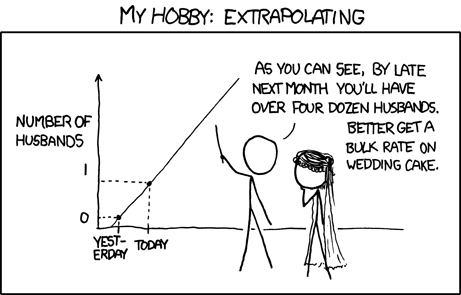
The Psuedoscience Thread

Talk about just about anything else that is non-gaming here, but keep it clean
User avatar
J T
Next-Gen
Posts: 12417
Joined: Wed Mar 25, 2009 6:21 pm
Location: Seattle

Re: The Psuedoscience Thread

Post by J T »

samsonlonghair wrote:
MrPopo wrote:
I don't believe in statistics.
Explain this. Do you not believe in addition or multiplication either?
This is the one that always get's people. How can it be untrue if you were taught this in math class? First of all, I will say there's no need to suggest that I don't believe in arithmetic. The basic laws of humble arithmetic are hard and fast. Let's not insult one another here.

Statistics are another matter. Often times statistics rely on circular reasoning. People who use statistics for proof forget that correlation is not cause. The data collection methods are often sketchy (if reported at all). Statisticians have methods of manipulating data.

In defense of statistics, sometimes statistics can (within some degree of accuracy) predict outcomes in large populations, but the statistics fall apart when you try to apply those predictions at the individual level.

I have made this argument several times, but I never manage to convince anyone. I suppose I need to work on my persuasion skills. Instead of rambling on about my own skepticism, I'll simply borrow a quote from Twain (who claimed to be borrowing it from Disraeli, but that's another matter).
Twain wrote:There are three kinds of lies: lies, damned lies, and statistics.
It sounds like your problem is more with statistics used poorly, rather than with statistics on the whole. If you know statistics well enough, you can get a pretty good sense of when it's being manipulated in service of making a point instead of in service of the truth.

You're also discussing problems in individual subject validity, which is a potentially very real problem and a reason to even take empirically supported advice with a small grain of salt, but it's generally not a huge problem and I still would still prefer to take a pill based on statistical support rather than take one based on anecdotal support.
My contributions to the Racketboy site:
Browser Games ... Free PC Games ... Mixtapes ... Doujin Games ... SotC Poetry
User avatar
Golgo 14
128-bit
Posts: 629
Joined: Sat Sep 20, 2008 3:26 am

Re: The Psuedoscience Thread

Post by Golgo 14 »

samsonlonghair wrote: Why don't we just put it to a simple test? Fill up a brita pitcher with tap water. Then fill up a regular pitcher with tap water. Place the two pitchers next to each other. Come back tomorrow and taste the water from each.
No need for that since apparently leaving a pitcher of water to sit for a few hours does reduce the chlorine. So presumably both pitchers would have reduced chlorine, filter or not. Hmm, I guess that does weaken Brita's argument unless you just want your water right now! In both cases you have the inconvenience of having to keep a pitcher.

I guess a faucet filter would be more attractive if those are as effective at reducing chlorine as the pitcher filter. You'd get the immediate reduced chlorine water and no need to keep a pitcher of water around all the time.

I'm bored.
marurun wrote: We’re not going to rubber stamp your horrible decisions.
User avatar
MrPopo
Moderator
Posts: 24190
Joined: Tue Aug 26, 2008 1:01 pm
Location: Orange County, CA

Re: The Psuedoscience Thread

Post by MrPopo »

Statistics is taking a large collection of data and coming up with a model that fits the data. You can then use that model to make predictions. Where it goes wrong is the need for proper context and data gathering. With data gathering, if you have garbage to build your model on top of then your model will be garbage. And proper context is where the lies, damned lies, and statistics quote comes in. Given the proper phrasing I can make a set of numbers say whatever I want.

Think of insurance companies. Their entire business model is based on statistics. They crunch the data and use that to come up with a pricing model. Clearly something is going right, as insurance is a thriving business (and to simplify things, let's just consider life insurance, which is all actuarial work).

So the problem you have isn't with statistics; it's with poorly presented or interpreted numbers. Here's a good example of a valid conclusion, but the sample size ends up being too small for the conclusion to be reasonable.
Image
Blizzard Entertainment Software Developer - All comments and views are my own and not representative of the company.
User avatar
Cronozilla
Next-Gen
Posts: 2609
Joined: Wed Mar 14, 2012 8:15 pm
Location: Oregon, USA.

Re: The Psuedoscience Thread

Post by Cronozilla »

Basically what MrPopo said:
There's a reason why statistics have confidence intervals. Just because someone trying to argue a point without using them doesn't mean that the field of statistics itself is bullshit. It really isn't. If it were a lot of the devices and services people use in their day to day lives would be ridiculously broken.

The times when those mathematical properties don't turn out to be remotely correct are when either someone has taken the result out of context, it was never calculated to a proper confidence level, or sample chosen to do the statistical analysis on was garbage.

People also abuse statistics, scientific findings, and all sorts of stuff to say their message. Or more likely, to get money.
It was mentioned, but yes, Dark Matter (and Dark Energy) are primarily abstract ideas to represent what is missing in universal calculations (since they need to be represented somehow to still do math on the universal model) People talking about it now are just trying to ponder, hey what would this unknown stuff actually be? And they attempt to extrapolate models of that to test with.

People do seem to be very uncomfortable with the idea that nothing is absolute. People want definitive, unchanging, answers ... and that just isn't something that exists in reality. Superstition and a lot of pseudoscience tries to offer that. Unwaveringly consistent constants.
User avatar
samsonlonghair
Next-Gen
Posts: 5188
Joined: Tue Feb 17, 2009 2:11 pm
Location: Now: Newport News, VA. Formerly: Richmond. Before that: Near the WV/VA border

Re: The Psuedoscience Thread

Post by samsonlonghair »

I expected to come back here and argue about statistics, but you guys are basically making my argument for me. I'm going to try to address all this in order. Sorry for an overly long post. Most of this is basically me agreeing with you, but seeing things from a slightly different (more skeptical) viewpoint.
J T wrote:It sounds like your problem is more with statistics used poorly, rather than with statistics on the whole.
Yes, this is one of my two main grievances with statistics.
J T wrote:You're also discussing problems in individual subject validity
Something like that. I have never heard the phrase "individual subject validity" before today. I would simply say that what's true of the flock is not necessarily true of the bird. This is my second main grievance.
J T wrote:which is a potentially very real problem and a reason to even take empirically supported advice with a small grain of salt, but it's generally not a huge problem and I still would still prefer to take a pill based on statistical support rather than take one based on anecdotal support.
But wouldn't it be even nicer to take a pill developed through empirical evidence and proven through rigorous tests?
MrPopo wrote:Statistics is taking a large collection of data and coming up with a model that fits the data.
Conspiracy theories also take a large collection of data and come up with a model that seems to fit. Aren't you skeptical when you hear a conspiracy theory? What invokes this skepticism? You have heard a hundred bogus conspiracies; I have heard too many bogus statistics. I hear nonsense statistics batted around with no one questioning the source or verifying these statistics in independent studies.

Numerology also takes a large collection of data and come up with a model that seems to fit. The number twenty-three seems to come up so often. Is there some uncanny significance to the number twenty-three? Of course not. It's a simple coincidence.
MrPopo wrote:Given the proper phrasing I can make a set of numbers say whatever I want.
You have made my point for me quite eloquently.
MrPopo wrote:Think of insurance companies. Their entire business model is based on statistics. They crunch the data and use that to come up with a pricing model. Clearly something is going right, as insurance is a thriving business (and to simplify things, let's just consider life insurance, which is all actuarial work).
Touché. You make a strong point considering actuarial science. Here we have an industry with the most rigorous statisticians. These guys are the best statisticians bar none, but can any among them tell me the day I will die? How about the month? Can the very best actuary tell me the year I will die? Doubtful. Models that apply to large sets of data do not necessarily apply on individual terms.
MrPopo wrote:So the problem you have isn't with statistics; it's with poorly presented or interpreted numbers. Here's a good example of a valid conclusion, but the sample size ends up being too small for the conclusion to be reasonable.
Yes, poorly presented or interpreted numbers is one of my problems with statistics. I think it's a reasonable criticism. I think anything short of a full census (or as near to one as reasonably possible) is too small a sample size.
Cronozilla wrote:The times when those mathematical properties don't turn out to be remotely correct are when either someone has taken the result out of context, it was never calculated to a proper confidence level, or sample chosen to do the statistical analysis on was garbage.
Indeed. You have also made my argument for me. I am not claiming the the mathematical concept of an average is flawed. The results of statistics are flawed.
Cronozilla wrote:People also abuse statistics, scientific findings, and all sorts of stuff to say their message. Or more likely, to get money.
Yes indeed. You make my point for me again.

Let me ask everyone this question:
How do you suppose that statistics would estimate themselves? What if you took every statistic in print from Jan 1st to Dec 31st then separated the results into two groups. Statistics that were collected responsibly, could be replicated with matching results elsewhere, and accurately predicted an outcome are in the group A. All other statistics are in group B. Which of these groups is larger? Statistically speaking, what percentage of statistics are valid? After you come up with a percentage, use that to predict whether or not the next statistic you read will be valid or bogus.

While that one is rolling around in your head, I leave you with some words from America's greatest philosopher.
Homer Simpson wrote:You can come up with statistics to prove anything, Kent. Forty percent of all people know that.
________
Cronozilla wrote:It was mentioned, but yes, Dark Matter (and Dark Energy) are primarily abstract ideas to represent what is missing in universal calculations (since they need to be represented somehow to still do math on the universal model) People talking about it now are just trying to ponder, hey what would this unknown stuff actually be? And they attempt to extrapolate models of that to test with.
Thanks for being the first to reply to Dark Matter. It seems to me that "Dark Matter" is the name cosmologists apply to their own ignorance. I don't mean to imply that cosmologists aren't smart. I just mean that "Dark Matter" isn't a thing; It's a great big "Here be dragons" on the map of the universe. I don't believe in dragons, and I don't believe in dark matter.
User avatar
Erik_Twice
Next-Gen
Posts: 6251
Joined: Fri Mar 27, 2009 10:22 am
Location: Madrid, Spain

Re: The Psuedoscience Thread

Post by Erik_Twice »

samsonlonghair wrote:Models that apply to large sets of data do not necessarily apply on individual terms.
Yeah, because they aren't meant to.

You seem to be arguing against a very flawed idea of what "Statistics" are not what the field actually is in reality.
Looking for a cool game? Find it in my blog!
Latest post: Often, games must be difficult
http://eriktwice.com/
User avatar
MrPopo
Moderator
Posts: 24190
Joined: Tue Aug 26, 2008 1:01 pm
Location: Orange County, CA

Re: The Psuedoscience Thread

Post by MrPopo »

samsonlonghair wrote:
MrPopo wrote:Think of insurance companies. Their entire business model is based on statistics. They crunch the data and use that to come up with a pricing model. Clearly something is going right, as insurance is a thriving business (and to simplify things, let's just consider life insurance, which is all actuarial work).
Touché. You make a strong point considering actuarial science. Here we have an industry with the most rigorous statisticians. These guys are the best statisticians bar none, but can any among them tell me the day I will die? How about the month? Can the very best actuary tell me the year I will die? Doubtful. Models that apply to large sets of data do not necessarily apply on individual terms.
So I think this is a misunderstanding of the point of statistics. Statistics doesn't say what WILL happen, it says what will likely happen. Given enough personal information about you to bucketize you, combined with their mountain of historical data on how long people live under various circumstances, the insurance company can say there's a 99% chance you'll live past age X, 90% chance you'll live past Y, and 50% chance you'll live past Z. They can then use that and calculate what monthly rate will give them a positive expected return for insuring you. And since it's probability based sometimes they lose; you could take out a policy, make one monthly payment, and then a piano falls on you and they have to pay out your $100,000 policy. But taken across the large number of customers they have they end up making money, as the majority fit the statistical model.
Indeed. You have also made my argument for me. I am not claiming the the mathematical concept of an average is flawed. The results of statistics are flawed.
Ok, I think I've figured out the issue. There's a semantical problem here; you seem to agree with the mathematical aspects of statistics but you are reasonably skeptical of how the numbers are presented. But that's not an indictment about statistics; that's an indictment of language. Here's another good example: my new crackers contain 50% the fat of the original crackers. Just multiplication here. And the naïve interpretation of what I've said makes it sound like my new crackers are great if you want to watch your weight. But then you look at the nutritional information and notice that the original crackers had 500 mg of fat per serving and the new crackers have 250 mg of fat per serving. Not really a big difference, nutritionally, but a completely accurate mathematical statement.
Cronozilla wrote:It was mentioned, but yes, Dark Matter (and Dark Energy) are primarily abstract ideas to represent what is missing in universal calculations (since they need to be represented somehow to still do math on the universal model) People talking about it now are just trying to ponder, hey what would this unknown stuff actually be? And they attempt to extrapolate models of that to test with.
Thanks for being the first to reply to Dark Matter. It seems to me that "Dark Matter" is the name cosmologists apply to their own ignorance. I don't mean to imply that cosmologists aren't smart. I just mean that "Dark Matter" isn't a thing; It's a great big "Here be dragons" on the map of the universe. I don't believe in dragons, and I don't believe in dark matter.

This is again a semantic issue you're getting hung up on. Scientists do not believe in dark matter in the sense you are implying that they do. Scientists have observed a higher amount of gravitational effects than can be explained through the visible matter. So there is some effect that is causing that, and a convenient name for the easiest explanation of it is that there is matter there that we cannot see, hence dark matter. It could very well be that solving the dark matter question is what lets us finally reconcile general relativity with quantum theory, and thus we would have the understanding of some new process which causes this extra gravity. Or it could be what's implied by the name; there's some matter out there that doesn't radiate and is thus undetectable to us.
Blizzard Entertainment Software Developer - All comments and views are my own and not representative of the company.
User avatar
Omerta
Next-Gen
Posts: 1030
Joined: Sun Mar 11, 2007 9:08 am
Location: Omicron Persei 8

Re: The Psuedoscience Thread

Post by Omerta »

samsonlonghair wrote: These guys are the best statisticians bar none, but can any among them tell me the day I will die? How about the month? Can the very best actuary tell me the year I will die? Doubtful.
Predicting your death is a losing proposition. If they're wrong, you're going to laugh at them. If they're right, you're not going to be around to acknowledge their statistical prowess. :D
"Farewell, good hunter.
May you find your worth
in the waking world."
User avatar
samsonlonghair
Next-Gen
Posts: 5188
Joined: Tue Feb 17, 2009 2:11 pm
Location: Now: Newport News, VA. Formerly: Richmond. Before that: Near the WV/VA border

Re: The Psuedoscience Thread

Post by samsonlonghair »

Omerta wrote:
samsonlonghair wrote: These guys are the best statisticians bar none, but can any among them tell me the day I will die? How about the month? Can the very best actuary tell me the year I will die? Doubtful.
Predicting your death is a losing proposition. If they're wrong, you're going to laugh at them. If they're right, you're not going to be around to acknowledge their statistical prowess. :D
Good one, Omerta.
oxymoron
Next-Gen
Posts: 2397
Joined: Mon Jul 22, 2013 2:35 pm
Location: Greater Los Angeles

Re: The Psuedoscience Thread

Post by oxymoron »

@samsonlonghair

So do you believe in gravity?
Image
Post Reply