Hatta wrote:I haven't felt the supposed boot of oppression on my neck.
Really? Do you expect to be able to own a house and keep a family of four fed on one salary like they did 50 years ago? If not, blame the 1%. If you haven't lost a job yet because of the credit crisis, you're just lucky. If you haven't fallen ill and gone bankrupt because of it, you're one of the lucky ones. Relying on your own personal luck as an argument for the status quo makes no more sens than justifying drunk driving by saying "I haven't hit anyone yet".
Right now I own a house but am single. I currently have no plans to have kids. But my coworker who makes the same as me feeds a family of 5 as the sole breadwinner. It's definitely feasible, but you do have to make some choices when it comes to your finances (which I'll get to when I talk about your picture). For me to be lucky for not having lost my job would mean that the unemployment would be >50%. That is not the case. Instead, those who have lost their job are unlucky. Similarly with those who are bankrupted by medical costs. I'm fairly certain the majority of the country isn't dealing with crippling medical costs. I have no problem with the notion that some people are going to lose in the game of life.
Also, it's hard to take the power back when the masses never had it to begin with. In every society you have the people at the top and everyone else. The rules never apply equally to everyone because there are always loopholes, and those with the power can exploit those loopholes. This is a constant feature across all societies.
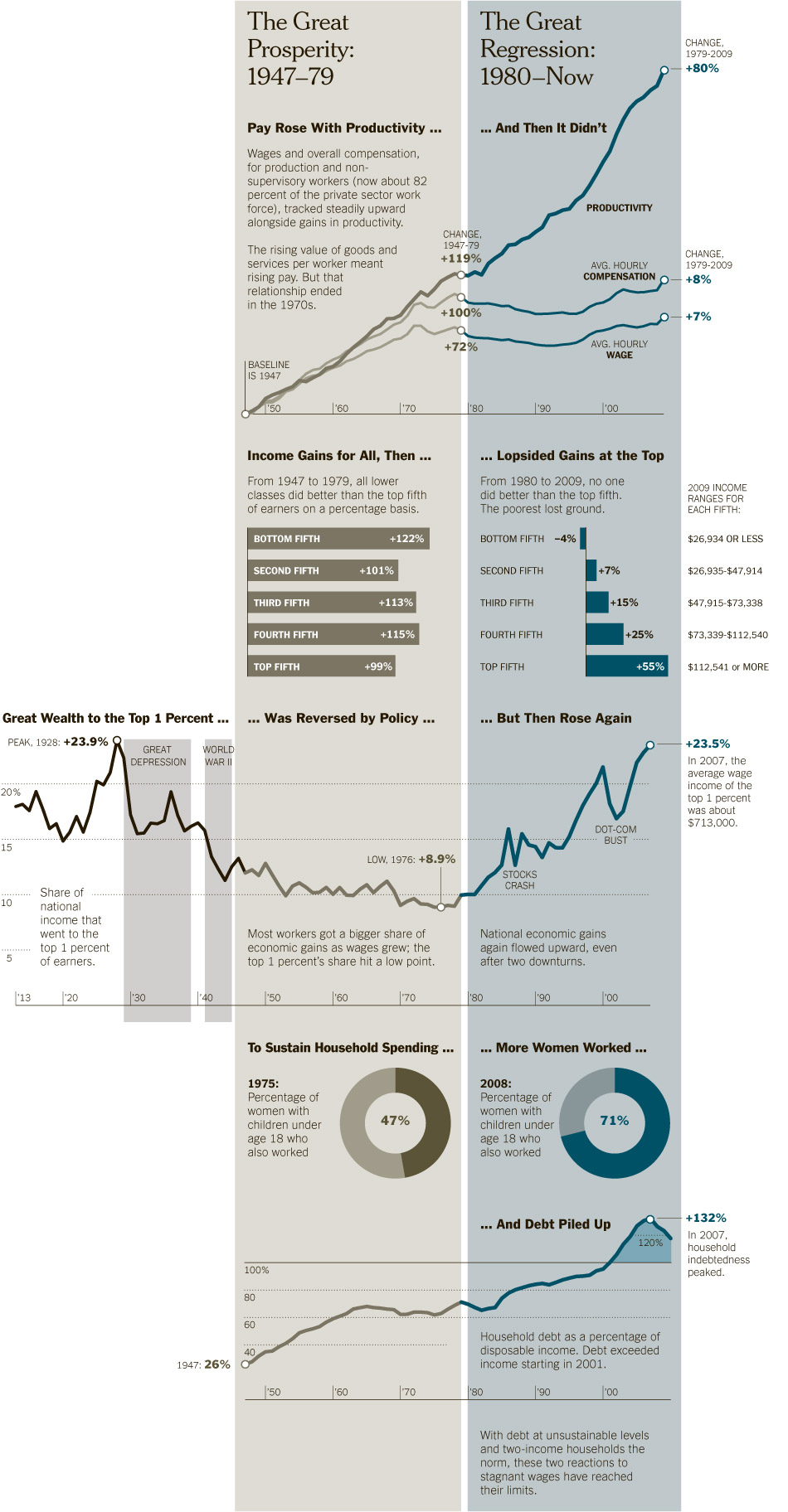
Basically what you're saying here is that policy doesn't matter. If policy didn't matter, corporations wouldn't spend so much on lobbying. You say that nothing changes, but look at
this chart. There are some very significant differences between eras, that seem to correlate quite nicely with political eras. We can turn these trends around. Why shouldn't we?
No, what I'm saying is what you originally said; whoever has the gold makes the rules. That's why corporations spend so much on lobbying.
Very interesting graph that you have there. I noticed that the other two graphs don't go back to the pre-Depression era. The pre-Depression era seems to mimic our current era in terms of wealth to the top 1%. I'm guessing that a good chunk of the wealth of those people is due to the stock market. Either straight up playing the market or being large shareholders of companies that do very well in the market (as a comparison, when I joined Amazon the stock was at 80, now it's at 240, and I know the split-adjusted value per share when Bezos started the company is ridiculously low). So after the depression wealth is created from more solidly tangible goods because of low confidence in the market. But then confidence picks back up and the value of any given security in the market increases over time. If you're giving your top people a ton of stock and the company does well their wealth is going to grow extremely fast by that metric. So as confidence in the stock market has grown we've seen that those who are invested heavily in it get a higher return.
The productivity graph seems misleading to me. How is it being defined? If it's raw value of goods being produced then that can be chalked up to automation. If I can get more stuff for the same amount of man hours worked then that's going to increase production without needing to increase wages. You don't need them to work any harder to produce more, whereas before you did.
As for the debt as a percentage of household income, that needs WAY more numbers behind it. Why is debt higher? I suspect it's related to credit cards. Mastercard was in '66, Visa in '70. The ability to make purchases without having to pay right away completely changes how people do their shopping. Especially when you can pay it off over a long period of time (albiet with a high interest rate). I'd be curious to see what debt to income looks like if you remove credit card debt.
I like the doom and gloom here, and the inevitibility that everyone will be without any capital at all. Where, precisely, will the top 1% get their money from then?
Nowhere. They'll die in a bloody revolution, as happens periodically. That's the way capitalism/feudalism is. Money makes money faster than work does, so the rich always get richer, and the poor always get poorer. Eventually the poor can't pay for their own bread and circuses, and the rich are too greedy to pay for the bread and circuses that keep the poor from storming their castles. Nobody likes bloody revolution, so lets try at least slowing the increase in inequality instead of accelerating it, as has been the case for the past 30 years.
See, now you're talking sense. I've always had you pegged as a wide-eyed idealist who thinks that we could live in a utopia where everyone gets what they need. It's good to see that you understand that the inequality is a natural part of people coming together.
Blizzard Entertainment Software Developer - All comments and views are my own and not representative of the company.