Pre-Video Games:


Before video games, there were arcades. In them there were often shooting galleries, very basic pinball tables, etc. There was also some game development that wasn't technically considered a video game because they were created on analog devices, such as William Higgenbotham's Tennis for Two created in 1958 on an analog computer.
Space War! (1962), The World's First Official Video Game


Space War! is the world's first official video game, played on the PDP-1 computer (seen above) often on college campuses, and created by Steve Russell in 1962. It is rumored that Nolan Bushnell (founder of Atari) attended a showing of this game and used it's concept to create his first arcade years later called Computer Space. The concept is simple. Two-players battle each other, each controls a rocket ship and they try to blast each other in outer space. However in the middle is a star, and you will be killed if you touch it, it even has it's own gravity well.
Computer Space (1971), The World's First Arcade Game


Computer Space, NOT Pong was the world's first arcade game. It is rumored that Nolan Bushnell (founder of Atari) attended a showing of the world's first video game, Space War!, and used it's concept to create his first arcade game in 1971 later called Computer Space. However despite it's place in video game history, it is received poorly.
The Magnavox Odyssey (1972), The World's First Home Console:


The world's first home video game console of any kind. Created by Ralph Baer (who later creates the Simon Says toy) and released in 1972. It was marketed to children as a toy. It was basically Pong, but without scores on the screen. Magnavox also released cards that are reminiscent of game cartridges, however they simply alter the existing game on the machine. They also released several screen covers that you put on your television screen to change or enhance the game.
Pong (1972) Creates The Video Game Arcade:


Nolan Bushnell's next arcade game is created as a result of learning from the mistakes of Computer Space. He realized that people wanted something simple, accessible, and fun. Pong soon became a huge hit, spawning several clone releases by other companies and even creating the first-generation of home consoles such as Pong, Super Ports, Color Sports TV Game, Wonder Wizard, and dozens more; as well as making video games a main attraction at the arcade. Soon, because of Pong's success, we saw classics such as Asteroids, Space Invaders, Pac-Man, and Donkey Kong in arcades. Pong was released the same year as The Magnavox Odyssey, but after it. In fact Magnavox sued Atari for using their concept in Pong without their permission, and Atari agreed to settle out of court. Ralph Baer had actually filed patents on Magnavox Odyssey years before it ever got released.
Atari 2600 (1977):

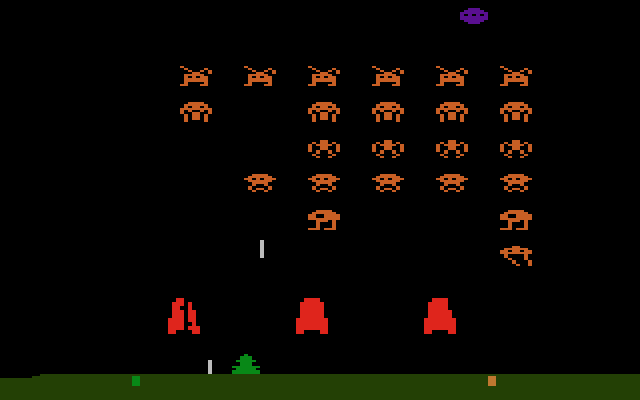
The second generation of home consoles really began with the rare Fairchild Channel F, which was the first console to be able to play different games using cartridges, it was released a year earlier. But it really didn't catch on, especially with it's strange controllers. Atari 2600 is really the system that brought gaming into the next generation. Thanks to arcade ports like Space Invaders, Ms. Pac-Man, Frogger, and Asteroids; gamers could now play their favorite arcade games at home, albeit a little downgraded in the graphics department. The system was so popular that it went through many different model incarnations and lasted 15 years, finally being discontinued in 1992. Significant games include: Space Invaders, Ms. Pac-Man, Frogger, Dig Dug, Donkey Kong, Pitfall, Defender, Adventure, Galaxian, Jungle Hunt, and others.
The Video Game Crash (1983):

In the late 70s, video games were booming new industry. Arcades were packed with people from all ages and walks of life. Home consoles like Atari 2600 and Magnavox Odyssey 2 were in people's homes. And Pac-Man Fever was sweeping the nation. But as quickly as the hype began, it just as quickly faded away it seemed. By 1983 the home video game market was bloated with too much product. Anyone and everyone were making video games it seemed, and with no quality control at the time, a lot of it was junk. Not only the games, but also the hardware was flooding the market. In 1983, you had the following systems active: Atari 2600, Atari 5200, Intellivision, Colecovision, Magnavox Odyssey 2, and dozens of Pong-clones. Because of this, and the leading belief that video games were nothing more than a fad at this time, arcades weren't faring much better. Some of the best games of the original arcade era were coming out in 1983, but sadly most people never played them. Soon video game development companies started closing shop and video games were seen on clearance racks. Ironically enough, PC gaming was alive and well during this time with the Commodore 64, Apple II Series, and Atari 400 & 800 that all had very innovative games coming out for them.
The Nintendo Entertainment System (1985):


The birth of a new generation was just looming over the horizon of the video game crash. Only nobody knew it. In Japan, there really was no video game market crash. The arcade business was still booming and the Japanese people were buying video games. A company named Nintendo released the Famicom in Japan in 1983. It was a big success. Such a big success that Nintendo made plans to release it in the U.S. But their timing couldn't have been worse. The video game crash was happening in the U.S. and retailers and distributors wanted nothing more to do with video games. So Nintendo decided to retool their Famicom to be marketed directly at Americans. They made it a front-loader to resemble a VCR, which at the time was high-tech and trendy. They also tried to market it as a toy, which is why they released it originally with ROB the Robot and the light-gun zapper. First, they tried to make a deal with Atari to distribute the system using their name, but the whole thing fell apart when Atari discovered that Nintendo had ported their hit game, Donkey Kong, to the Colecovision, Atari's main-competitor. Undaunted, Nintendo went ahead with the release by themselves. It began as a limited release in New York, and was a huge success. They then released it to the U.S., and rest is, as they say, history. Nintendo had saved the dying home video game industry. Historic games include Super Mario Bros. 1-3, The Legend of Zelda 1 & 2, Metroid, Double Dragon 1-3, TMNT series, Mega Man 1-6, Castlevania 1-3, Contra, and others.
Super Mario Bros.


A big reason for the NES's success had to do with a plumber named Mario. Created by Shigeru Miyamoto (who also created Donkey Kong and The Legend of Zelda), Mario was originally named Jumpman and was the main-character in Nintendo's hit arcade game Donkey Kong. He then appeared in another arcade hit for Nintendo in his first official appearance as Mario as well as the debut of Luigi in the classic Mario Bros. But it was Super Mario Bros. for the NES that rocketed the mustached hero into super-stardom and cemented Nintendo as a main-player in the home console market. It was geniusly placed as the pack-in game, along with Duck Hunt on the same cartridge, the game you get in the box with your NES system. In the game you guide Mario on a 2D side-scrolling, platforming quest through the Mushroom Kingdom to save Princess Peach and in the process also save the Mushroom Kingdom from the evil King Koopa and his minions. Along the way you'll run into a number of enemies, obstacles, and power-ups including everyone's favorite: the Fire-Flower; as you collect coins, break blocks, and destroy King Koopa's minions.
Game Boy (1989):


Before Game Boy, there was handheld gaming, believe it or not. Things like home table-top arcades like Donkey Kong, handheld dedicated sports games, Nintendo's Game & Watch series, and Tiger Electronics dedicated handhelds. But the rampant success that is handheld gaming today can be directly traced back to the original Game Boy created by Gunpei Yokoi, who also created Nintendo's successful Game & Watch series of dedicated handhelds. Game Boy was released in 1989. It had monochrome color, no back-light, and was a bit bulky. But it worked, and even though it was monochrome, the graphics worked for monochrome and looked good on many games. The original pack-in game for Nintendo's Game Boy was Tetris, and that game being a pack-in made Game Boy a BIG seller. People really wanted Tetris on the go it seemed. Game Boy's large and diverse library of games also made this a sure-fire hit as the Game Boy has a game for every taste. 64.42 million Game Boys have been sold worldwide, if you combine Gameboy Color with that number it jumps to 118.69 Million, nearly double. The runaway success of the Game Boy did not go unchallenged, however. Atari released it's all-color, backlit handheld The Atari Lynx shortly after the Game Boy was released in 1989. Sega released the color, back-lit Sega Game Gear in 1991. Atari's Lynx flopped, and while the Sega Game Gear was fairly well-received, it did not achieve the same success as Game Boy.
Sega Genesis (1989):


There were many systems released to compete with the fan-favorite NES after it's successful debut including Sega's first home console (first in the U.S. at least) The Sega Master System, as well as Atari's own attempt the Atari 7800. Neither could dethrone Nintendo's apparant reign over the market. However in 1989 Sega was about to become Nintendo's biggest competition, and it's first true challenger in the marketplace. Sega released the Sega Genesis (aka the Sega Mega-Drive) in 1989. The release of this system created a rivalry between Sega and Nintendo that would continue on for more than a decade. The Sega Genesis was more powerful than the Nintendo, it could create more colors and better graphics than the Nintendo, it was sleek and stylish, and it had stereo sound. Nintendo realized they had a real contender and as a result this prompted Nintendo to begin work on their own 16-bit system. This led to other companies such as Sony and Microsoft later on being able to enter the video game market. Sega Genesis boasted many arcade hits in it's library including Space Harrier II, After Burner II, Golden Axe, Mortal Kombat, Street Fighter, Lethal Enforcers, Streets of Rage, and others. And it has a large number of fan-favorite exclusives including Sonic the Hedgehog, Vectorman, Shinobi III, Casstlevania: Bloodlines, and others. Sega even had it's own popular mascot and gaming character of it's own to rival Nintendo's Mario: Sonic the Hedgehog.
The 16-bit Era:


The 16-bit era began with NEC's TurboGrafx-16. The first true 4th generation console released in 1988. It did fairly well, but still had a long ways to go to dethrone Nintendo's NES. It is often remembered for it's space-ship shoot-em ups and the Bonk's Adventure series, as well as the RPG series Ys. But for the majority of the gaming public, the 16-bit era really began when the more powerful than the NES, Sega Genesis was released. Sega has become Nintendo's first true competition and started a decade long rivalry between the two companies. As a result, Nintendo created the Super Famicom released in Japan in 1990, and the Super Nintendo released in the U.S. in 1991. It was everything you loved about NES, but better: better graphics and more colors, better sound, and bigger games. The home video game business was booming again, as it had before the crash. In addition to Sega Genesis and Super Nintendo, Neo-Geo also released a 16-bit system that was leaps and bounds better than either system. However it was also leaps and bounds more expensive. It was likely only wealthy gamers got to experience the arcade-perfect system. Also during this era was the advent of CD-Roms being used in consoles. TurboGrafx-16 and Sega Genesis both received CD add-ons to play CD-Rom games as well as music CDs. These add-ons enhanced graphics, and greatly enhanced sound, as well as gave programmers a lot more space to work with than on a traditional cartridge, making it possible to make much bigger and more media-rich games. Significant games of this era include: Super Mario World, Super Mario Kart, Street Fighter II, Mortal Kombat series, Sonic the Hedgehog series, Golden Axe, Super Metroid, Sim City, Wolfenstein 3-D, and others.
Street Fighter II Breathes New Life Into Arcades:
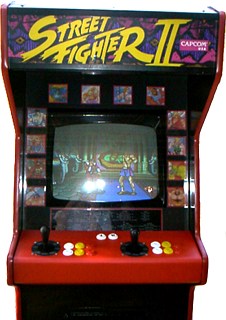

While the home console market was saved by Nintendo with NES and continued to thrive, the arcade market was still reaching for the numbers they had pulled in years before. Enter Capcom. In 1987 Capcom released a one-on-one fighting game to arcades known as Street Fighter. It did not do as well as they hoped. Why they decided to do a sequel, who knows? But thankfully they did, and a fighting game classic was created who's legacy still exists and thrives to this day. Soon people were lined-up at Street Fighter II machines around the world trying to prove who was the best Street Fighter II player. It became a phenomenon that spawned many sequels, an anime, and even a hollywood movie. The game was ported to home consoles such as Sega Genesis and Super Nintendo. Soon after the success of Street Fighter II, many other popular fighting franchises were released including the controversial (at the time) Mortal Kombat, Fatal Fury, King of Fighters, Samurai Shodown, Virtua Fighter, and others. And the arcade business in general benefited the fighting game-fad that brought in more people to the arcades to play all the games offered. Today the arcade market is still thriving...in Japan. In the U.S. home consoles have clearly become the preferred choice for gamers and arcades are being seen less and less. It's time for another Street Fighter level of success game or arcades may soon be a thing of the past in the U.S.
3D Gaming Explodes:


With the advent of CD-Rom add-ons such as the Sega CD, TurboGrafx CD, and Atari's Jaguar console; programmers found it easier to use 3D polygons in their game design than ever before. Many programmers used the CD add-ons to experiment with this, which unfortunately for us gamers didn't always result in good games. Many early attempts looked crude, however some were still very fun. Games such as Star Fox, Doom, Wolfenstein 3D, and Star Wars: Rebel Assault. A result of this experimentation led to systems like the 3DO, the Sega Saturn, and the oh-so-popular Sony Playstation, and eventually the Nintendo 64; which were made with the intention of 3D games being run on them. Soon gaming entered yet another boom. During this time gamers from all ages came back to gaming again, as in the days before the Video Game Crash. Before this, during the days of the NES and 16-bit era, games were mostly considered kids stuff. Now realistic graphics and cinematic storytelling drew people from all walks of life into gaming. For Sega fans, however, this marked not only the beginning of a new era for gaming, but also the end of an era. At what is arguably considered the the end of the early 3D era, Sega discontinued the Sega Dreamcast in 2001, marking the last time Sega would be in the home console business. Since then Sega has been a software only company. Sega's void in the console market is still felt by many gamers today, including myself. Significant games of this era include: Final Fantasy VII, Resident Evil, Golden Eye: 007, Super Mario 64, The Legend of Zelda: Ocarina of Time, Metal Gear Solid, Tomb Raider, Twisted Metal, Nights Into Dreams, Panzer Dragoon, Sonic Adventure, Shenmue, Doom, Diablo, and others.
Gaming Today:

The video game market continues to evolve. The last-generation and the current generation saw a steady increase in graphical capabilities, games sizes, and more powerful hardware. The market continues to thrive as more people than ever are gaming, and the game industry is now the biggest money maker in the entertainment world. Console developers continue to push the edge of what a video game is with new concepts such as motion-controls like Wii, Playstation Move, and Kinnect, online gaming and networks, touchscreens, and new 3D technology. Now we're hearing rumors that the next-generation is just around the corner with rumors and teases about the Nintendo Wii 2, XBox 3, PSP 2, as well as the recently released Nintendo 3DS handheld. At the moment Nintendo, Sony, and Microsoft lead the market with their Wii, Playstation 3, and XBox 360 consoles, and Sony's PS2 still hanging on from the last-generation even. Nintendo and Sony lead the handheld market with Nintendo DS, Nintendo 3DS, and PSP. What does gaming hold in it's future? You have to keep gaming to find out. Current popular games include: Halo series, Gears of War 1 & 2, Little Big Planet 1 & 2, God of War 1-3, Fallout 3, Elder Scrolls IV: Oblivion, World of Warcraft, New Super Mario Bros., Call of Duty series, Guitar Hero Series, Grand Theft Auto Series, and others.